

Airports operate some of the most complex and demanding environments in the transportation industry. Every day, thousands of passengers, employees, vehicles and mobile assets move across terminals, baggage handling areas, maintenance facilities and airside zones.
Managing these operations efficiently requires more than traditional inventory systems and manual equipment checks. Airport operators need real-time visibility into the location, availability and utilization of their resources to reduce operational delays, improve productivity and deliver a seamless passenger experience.
Airport Asset Tracking and Real-Time Location Systems (RTLS) provide a practical solution to these challenges. By combining Bluetooth Low Energy (BLE), Wi-Fi infrastructure, mobile positioning and location analytics, airports can transform existing wireless networks into intelligent operational environments.
From baggage trolley management and Ground Support Equipment (GSE) tracking to staff coordination and passenger assistance equipment, real-time location technology helps airport operators make better decisions based on accurate operational data.
Pole Star delivers these capabilities through its NAO® Suite, an end-to-end indoor positioning and RTLS platform designed to track assets, people and equipment across complex indoor and outdoor environments.
1. What Is Airport Asset Tracking?
Airport asset tracking is the process of identifying, locating and monitoring physical assets throughout airport facilities using real-time location technologies.
These assets can include:
- Baggage trolleys and passenger carts.
- Ground Support Equipment (GSE).
- Baggage tractors and airside vehicles.
- Passenger mobility equipment, including wheelchairs.
- Maintenance tools and operational equipment.
- Mobile devices and workforce resources.
Traditional asset management relies heavily on manual inventory checks, spreadsheets and communication between operational teams. These methods can make it difficult to identify where equipment is located, whether it is available or how efficiently it is being used.
An airport asset tracking system replaces fragmented information with a centralized, real-time view of operational resources.
Using BLE tags, Wi-Fi positioning and mobile devices, airport teams can:
- Locate equipment on digital indoor maps.
- Monitor asset availability across terminals and operational zones.
- Identify misplaced or inactive equipment.
- Set up geofencing alerts when assets enter or leave predefined areas.
- Analyze equipment utilization and movement patterns.
- Improve resource allocation and operational planning.
The result is a more connected airport environment where operational teams can access actionable location data instead of relying on manual searches.
2. Ground Support Equipment Tracking: Improving Airport Ground Operations
Ground Support Equipment (GSE) plays a critical role in airport operations. From baggage tractors and belt loaders to service vehicles and other ground handling equipment, these assets support the efficient turnaround of aircraft.
However, managing large fleets across multiple terminals, service areas and airside zones can create significant operational challenges.
Without real-time visibility, ground handling teams may spend valuable time searching for available equipment, coordinating resources or checking vehicle availability.
Ground Support Equipment Tracking provides a way to monitor equipment locations and improve fleet utilization.
With an RTLS platform, airport operators and ground handling companies can:
- Locate baggage tractors and other operational vehicles.
- Monitor the distribution of equipment across operational areas.
- Identify underutilized or inactive assets.
- Improve coordination between ground handling teams.
- Monitor equipment movements between designated zones.
- Support faster operational decision-making.
Depending on the equipment and operational requirements, tracking can be implemented using BLE tags or mobile positioning technologies.
For example, smartphones equipped with a positioning solution can be used to locate personnel and vehicles without necessarily installing dedicated tracking hardware on every vehicle.
By consolidating location information into a single operational interface, airport managers gain better visibility over their ground operations.
3. Baggage Trolley Management: Ensuring Equipment Availability Across Terminals
Baggage trolley management is one of the most visible challenges for airport operators.
Thousands of passenger trolleys circulate throughout terminals, arrivals areas, departure halls and baggage claim zones. Ensuring that the right number of trolleys is available in the right location at the right time requires continuous monitoring and redistribution.
Without reliable tracking, operational teams often depend on manual counting and periodic collection rounds.
This can result in:
- Trolley shortages during passenger peak periods.
- Excessive accumulation in certain areas.
- Increased time spent searching for equipment.
- Unnecessary redistribution operations.
- Poor visibility into actual trolley utilization.
How does smart trolley tracking work?
A Smart Trolley Airport solution combines BLE tags with an existing BLE-compatible Wi-Fi infrastructure.
The process typically follows three steps:
1. BLE tag deployment
Each baggage trolley is equipped with a small Bluetooth Low Energy tag that continuously broadcasts its signal.
2. Signal detection
BLE-compatible Wi-Fi access points detect signals emitted by the tags across the airport terminals.
3. Real-time positioning and counting
The RTLS platform processes the signals to calculate trolley positions and display their locations on digital maps.
The platform can also count the number of trolleys present in each predefined operational zone.
Airport teams can therefore identify shortages, monitor distribution and optimize trolley redistribution based on actual demand.
From trolley tracking to trolley fleet management
Beyond locating individual assets, a comprehensive trolley fleet management solution provides operational analytics.
Airport operators can monitor:
- Number of available trolleys per terminal or zone.
- Distribution of the trolley fleet.
- Areas experiencing recurring shortages.
- Equipment inactivity and utilization patterns.
- Alerts associated with unexpected movements.
- Historical fleet performance.
This transforms baggage trolley management from a reactive process into a data-driven operation.
Real-world example: Paris Charles de Gaulle Airport
At Paris Charles de Gaulle Airport (CDG), Pole Star deployed its NAO® Suite platform to support the real-time tracking and counting of 6,200 passenger baggage trolleys.
Developed in collaboration with Atalian, Hub One and Cisco, the solution uses BLE tags installed on trolleys and the airport’s existing Cisco Wi-Fi infrastructure.
The system provides operational teams with real-time visibility into trolley locations and availability across airport terminals.
Through centralized supervision and zone-based counting, teams can better manage trolley distribution, identify shortages and optimize operational interventions.
This project demonstrates how airport asset tracking can improve the management of large equipment fleets without requiring a completely separate wireless infrastructure.
4. BLE Tags and Wi-Fi Location Analytics: Building a Connected Airport
Modern airport asset tracking solutions rely on wireless technologies to provide accurate and scalable positioning.
Two particularly relevant technologies are Bluetooth Low Energy (BLE) and Wi-Fi.
BLE Tags for Airport Asset Tracking
Bluetooth Low Energy tags are compact, energy-efficient devices that periodically broadcast identification signals.
They can be attached to mobile equipment such as:
- Baggage trolleys.
- Ground Support Equipment.
- Passenger mobility equipment.
- Maintenance tools.
- Operational containers.
BLE technology is particularly suitable for tracking large fleets of mobile assets because tags can operate with low energy consumption.
When detected by compatible wireless infrastructure, BLE signals can be processed by an RTLS platform to determine the location of tagged equipment.
Wi-Fi Location Analytics Airport
Many airports already operate extensive Wi-Fi networks throughout their terminals and operational facilities.
Where compatible BLE-enabled access points are available, this infrastructure can also support indoor positioning and asset tracking.
This creates an opportunity to leverage existing wireless investments rather than deploying an entirely new positioning infrastructure.
Wi-Fi and BLE positioning can help airport operators:
- Track tagged equipment across multiple zones.
- Monitor asset movements.
- Generate real-time location events.
- Analyze equipment distribution.
- Support operational dashboards and reporting.
The appropriate positioning technology depends on the required accuracy, existing infrastructure, environment and type of asset being tracked.
Why infrastructure interoperability matters
Airport technology environments are rarely built around a single vendor.
They often combine networking equipment, operational management systems, security platforms and specialized applications.
An airport IoT platform should therefore be capable of integrating with existing infrastructure and distributing location data through APIs and standardized interfaces.
Pole Star’s NAO® Suite is designed to work with existing BLE and Wi-Fi environments, including compatible Cisco and HPE Aruba infrastructure.
This approach supports scalable deployments while helping airports maximize the value of their existing technology investments.
5. Airside Vehicle Tracking and Airport Fleet Management
Airport operations extend far beyond passenger terminals.
Airside environments involve a continuous flow of vehicles, ground handling equipment, service teams and operational personnel.
Knowing where these resources are located is essential for coordinating activities and improving operational visibility.
Airside vehicle tracking enables airport operators and ground handling companies to monitor vehicle positions across designated operational areas.
Depending on the deployment architecture, positioning can combine indoor and outdoor location technologies.
For example, NAO® Mobile can support the location of smartphones carried by operational personnel or associated with mobile equipment.
This approach can help teams:
- Identify the location of operational resources.
- Improve coordination between ground agents and vehicles.
- Monitor movements across indoor and outdoor areas.
- Improve the visibility of baggage handling workflows.
- Support operational supervision.
- Analyze activity across different zones.
Supporting baggage handling operations
Baggage handling operations depend on efficient coordination between people, vehicles and equipment.
When teams have limited visibility into the location of resources, operational delays can occur.
Real-time positioning provides additional information to support the coordination of baggage handling activities.
By combining asset tracking, mobile positioning and operational dashboards, airport teams can obtain a more complete view of their activities.
6. Lone Worker Safety: Improving Workforce Visibility in Airports
Airports are large operational environments where employees may work across isolated technical rooms, maintenance facilities, baggage handling areas and restricted operational zones.
Maintaining visibility over workforce distribution is important for both operational coordination and worker safety.
A lone worker airport solution can use location technologies to help supervisors identify the positions of employees carrying compatible professional smartphones or devices.
With an appropriate application and integration architecture, location information can support:
- Real-time workforce visibility.
- Identification of employees within predefined zones.
- Geofencing and entry or exit notifications.
- Coordination of field interventions.
- Faster identification of an employee’s last known position.
PTI/DATI Airport: Supporting Isolated Worker Protection
PTI (Protection du Travailleur Isolé) and DATI (Dispositif d’Alarme pour Travailleur Isolé) systems are designed to support employees working alone.
Location technology can complement these systems by providing contextual information about the employee’s position when an alert is triggered.
For example, when integrated with a compatible alarm or safety application, an RTLS platform can provide location information to help supervisors identify the relevant operational area.
It is important to distinguish between location tracking and a complete certified worker protection solution: RTLS provides positioning capabilities, while alarm triggering, communication and emergency response depend on the associated safety devices and systems.
This makes location technology a valuable component of a broader airport workforce safety architecture.
7. Passenger Assistance Mobility Equipment: Improving Accessibility
Passenger experience is directly influenced by the availability of assistance equipment throughout airport facilities.
Wheelchairs and other passenger mobility equipment must be accessible where and when passengers need them.
However, managing these resources across large terminals can be challenging, particularly during peak travel periods.
Passenger assistance mobility equipment tracking provides airport operators with better visibility into the location and distribution of these assets.
By attaching BLE tags to compatible equipment, teams can:
- Locate available wheelchairs.
- Monitor equipment distribution across terminals.
- Identify areas with insufficient equipment.
- Reduce the time spent searching for available resources.
- Analyze usage patterns and improve resource allocation.
For airport assistance teams, this can support more efficient coordination and contribute to a smoother passenger experience.
Importantly, the objective is to improve equipment availability and operational visibility, not to track passengers themselves.
8. Airport Facility Management Digitalisation
Airport facility management involves coordinating a wide range of resources, infrastructure and maintenance activities.
From technical equipment and maintenance tools to mobile assets and operational devices, facility managers need reliable information to maintain service continuity.
Traditional facility management processes can create information gaps when equipment locations are not continuously updated.
Digital location intelligence provides an additional layer of operational visibility.
With an airport RTLS platform, facility management teams can:
- Locate maintenance equipment and tools.
- Monitor the movement of mobile assets.
- Identify equipment that remains inactive for extended periods.
- Receive alerts when assets leave predefined areas.
- Analyze equipment utilization.
- Support maintenance and operational workflows.
From asset location to operational intelligence
The value of airport asset tracking goes beyond knowing where equipment is located.
Location data can be used to identify operational patterns, improve resource allocation and support evidence-based decisions.
For example, historical location data can help facility managers understand which areas generate the highest equipment demand, where resources accumulate and where redistribution is required.
This information supports the digitalisation of airport facility management and contributes to more efficient resource planning.
9. Supporting Baggage Handling System Modernisation and AODB Environments
Airport modernisation projects increasingly require different operational systems to exchange information.
Baggage handling systems, airport operational databases, maintenance platforms and facility management applications each serve specific purposes.
Real-time location technology can complement these environments by providing an additional source of information about the physical location and movement of assets.
Baggage Handling System Modernisation
Modernising baggage handling operations is not limited to upgrading conveyors or automated sorting systems.
It also involves improving the visibility of the mobile resources supporting baggage operations.
For example, baggage tractors, trolleys and other mobile equipment can be tracked to support coordination between operational teams.
Location data can complement existing baggage handling systems by adding information about equipment availability and movement.
AODB Asset Management
An Airport Operational Database (AODB) centralizes operational information related to airport activities, such as flight schedules, aircraft movements and other operational data.
However, an AODB and an RTLS platform do not serve the same purpose.
An RTLS platform provides real-time location information about physical assets, vehicles and personnel.
Through APIs and suitable system integrations, location information can potentially be shared with wider airport IT environments, including operational dashboards and AODB-connected applications.
This creates opportunities to connect asset visibility with broader airport operational processes.
The integration architecture must be defined according to the airport’s existing systems, interfaces and data governance requirements.
10. What Should Airports Look for in an Airport IoT Platform?
Selecting an airport IoT platform requires evaluating more than its ability to display asset positions on a map.
Airport environments demand scalable, interoperable and reliable technologies capable of supporting multiple operational use cases.
The following capabilities should be considered when evaluating an airport asset tracking solution.
| Evaluation criteria | What airport operators should look for |
|---|---|
| Real-time positioning | Continuous visibility into assets and mobile resources |
| BLE compatibility | Support for BLE tags and existing wireless infrastructure |
| Wi-Fi integration | Ability to leverage compatible existing access points |
| Indoor/outdoor positioning | Continuity across terminals and operational areas |
| Geofencing | Automated alerts based on predefined geographical zones |
| Asset counting | Real-time equipment counts by operational area |
| Analytics | Historical data, utilization indicators and operational reporting |
| Interoperability | APIs and integration with existing airport systems |
| Deployment flexibility | Cloud, on-premise or hybrid architecture |
| Scalability | Ability to support thousands of tracked assets |
| Data governance | Security, access control and appropriate data management |
A modular architecture is particularly important.
Airport operators may want to start with baggage trolley tracking and subsequently extend the deployment to GSE, maintenance equipment, workforce visibility or passenger assistance equipment.
A platform that supports multiple use cases can reduce technological fragmentation and provide a common foundation for future digitalisation projects.
11. How Pole Star Supports Airport Asset Tracking with NAO® Suite
Pole Star provides indoor positioning and Real-Time Location System (RTLS) technologies through its NAO® Suite.
Designed for complex environments, NAO® Suite combines infrastructure, positioning engines and software applications to capture, calculate, distribute and visualize location data.
The platform supports real-time location services for airport operations, including baggage cart tracking, asset management, workforce coordination and operational analytics.
One platform, multiple airport use cases
NAO® BlueSpot and NAO® BlueListener – Infrastructure
These components support the capture and transmission of BLE signals, depending on the deployment architecture.
NAO® Track – Real-Time Positioning Engine
Processes location signals to calculate the positions of tagged assets and other supported devices in real time.
NAO® Mobile SDK – Mobile Positioning
Enables indoor positioning capabilities within compatible mobile applications, supporting workforce and mobile asset use cases.
NAO® Cloud and NAO® Server – Platform
Manage location services and distribute positioning data through cloud or on-premise deployment architectures.
NAO® Viewer – Real-Time Supervision
Provides operational teams with a visual interface to monitor assets, view their positions on digital maps and supervise location events.
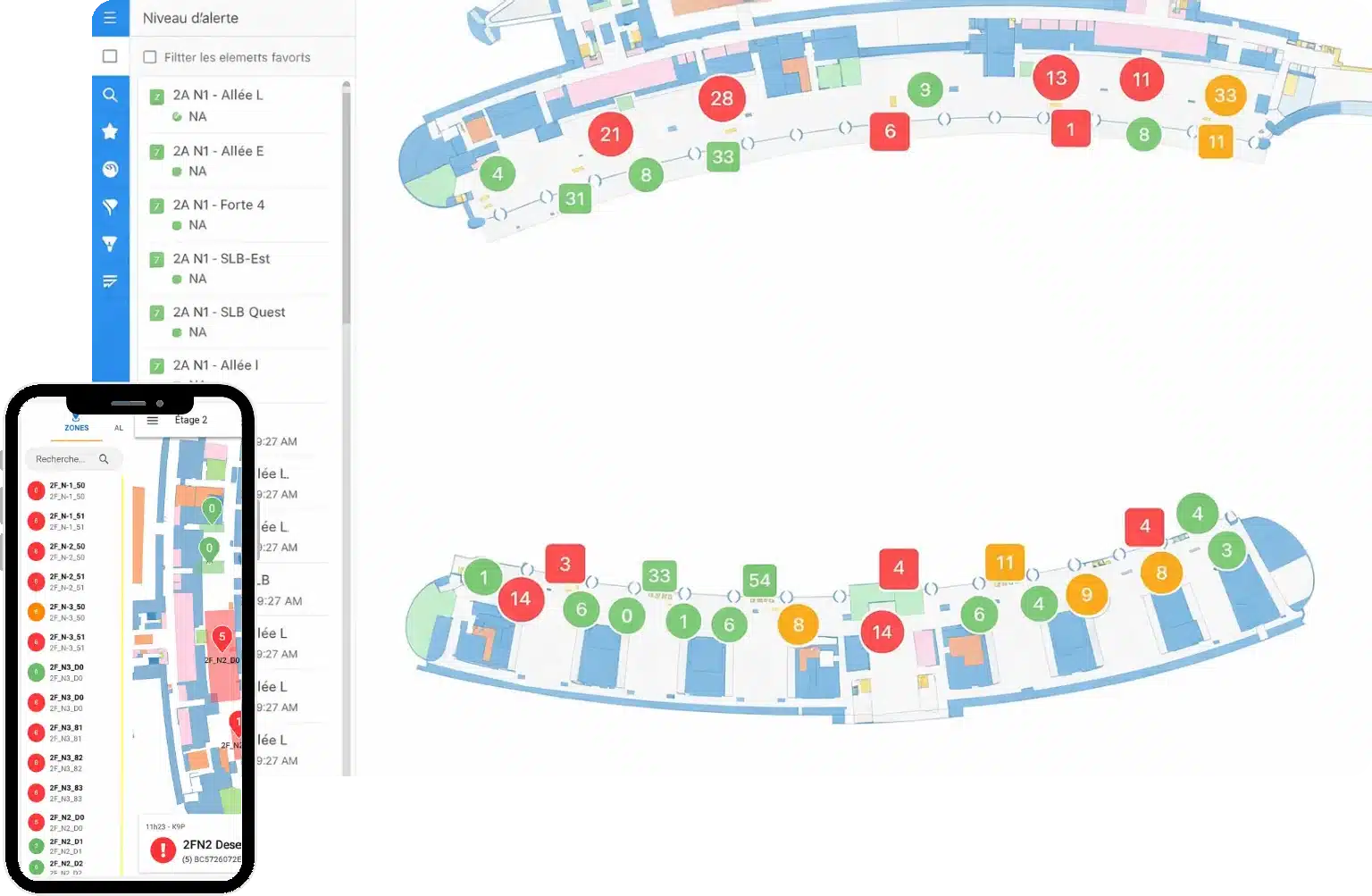
NAO® Flow – Location Data and Movement Analytics
Supports the analysis and use of location data to understand movements and operational flows.
NAO® Counting – Occupancy and Counting
Provides counting capabilities by predefined zones, depending on the configured use case.
Built to work with existing airport infrastructure
One of the key advantages of Pole Star’s approach is its ability to leverage compatible existing wireless infrastructure.
Rather than requiring airports to replace their entire network, NAO® Suite can work with compatible BLE and Wi-Fi infrastructure, including Cisco and HPE Aruba environments.
The solution can also be deployed using cloud, on-premise or hybrid architectures, depending on operational and IT requirements.
This flexibility helps airport operators adapt the technology to their existing infrastructure, security policies and digital transformation strategies.
12. The Business Benefits of Airport RTLS
Implementing an airport asset tracking system can generate measurable operational improvements across multiple departments.
The most relevant benefits include:
Reduced equipment search time
Employees can locate available assets through real-time digital maps rather than relying on manual searches.
Improved asset availability
Zone-based counting and distribution analytics help identify shortages and optimize equipment allocation.
Better fleet utilization
Historical location data provides insights into how equipment is distributed and used.
Reduced equipment losses
Geofencing and location alerts can help identify unexpected asset movements.
Improved workforce coordination
Supervisors gain better visibility into operational resources and field activities.
Data-driven operational decisions
Location analytics provide measurable indicators to support continuous operational improvement.
Improved passenger experience
Better availability of baggage trolleys and passenger assistance equipment contributes to smoother airport operations.
The return on investment depends on the size of the deployment, existing infrastructure, operational processes and the specific KPIs selected by the airport operator.
Conclusion: Choose Pole Star to Power the Next Generation of Smart Airports
As airport operations become increasingly complex, real-time visibility is no longer just an operational advantage. It is a strategic requirement.
From baggage trolley management and Ground Support Equipment (GSE) tracking to workforce visibility, passenger assistance equipment and airport facility management, airport operators need a reliable technology partner capable of addressing multiple operational challenges through a unified location platform.
Pole Star is that partner.
With over 20 years of expertise in indoor positioning and Real-Time Location Systems (RTLS), Pole Star delivers the technology, flexibility and interoperability required to transform airport operations. Through its NAO® Suite, Pole Star provides a comprehensive platform combining BLE, Wi-Fi and mobile positioning technologies to track assets, monitor equipment availability and turn real-time location data into actionable operational intelligence.
Unlike fragmented tracking solutions designed for individual use cases, NAO® Suite offers a scalable and modular approach, allowing airports to address multiple operational requirements through a common technology platform while leveraging compatible existing wireless infrastructure.
And this is not just a technological promise. At Paris Charles de Gaulle Airport, Pole Star’s technology has already demonstrated its value through the tracking and management of 6,000 baggage trolleys, providing operational teams with real-time visibility and helping optimize equipment distribution and availability.
Why choose Pole Star for your airport RTLS project?
- Proven airport expertise: Real-world deployments in demanding airport environments.
- One platform, multiple use cases: Track baggage trolleys, GSE, mobile assets and workforce resources.
- Infrastructure interoperability: Leverage compatible Cisco and HPE Aruba Wi-Fi and BLE infrastructure.
- Scalable architecture: Support thousands of assets and evolving operational requirements.
- Actionable location intelligence: Transform positioning data into operational insights, analytics and improved resource management.
- Deployment flexibility: Adapt your RTLS architecture to your IT infrastructure and security requirements.
Whether you are planning a new airport asset tracking deployment, modernizing existing baggage handling operations or preparing an airport digital transformation project, Pole Star provides the expertise and technology to make it happen.
Don’t just track your airport assets. Take control of your entire operational environment.
Choose Pole Star and NAO® Suite as your RTLS technology partner to build smarter, more connected and more efficient airport operations.
Ready to transform your airport operations?
Contact Pole Star’s airport experts to discuss your project and discover how NAO® Suite can address your operational requirements.
Frequently Asked Questions (FAQ)
What is airport asset tracking?
How does an airport asset tracking system work?
What is Ground Support Equipment (GSE) tracking?
How can airports improve baggage trolley management?
What are BLE tags used for in airports?
Can airport asset tracking use existing Wi-Fi infrastructure?
What is an Airport RTLS platform?
Can RTLS support lone worker safety in airports?
What is the difference between an AODB and an airport asset tracking system?
How does Pole Star support airport asset tracking?
Contact Pole Star →