
Executive summary
European airports operate as interconnected critical infrastructures. Their ability to function depends not only on terminals, runways and security systems, but also on complex relationships between airport operators, airlines, ground handlers, public authorities, emergency services, technology providers and other operational partners.
In its Strategy Paper on Hybrid Threats and Airport Resilience, ACI EUROPE calls for a more integrated approach to airport resilience, bringing together aviation security, cybersecurity, operational continuity and crisis management. The paper also underlines that airports cannot address hybrid threats alone. Effective resilience requires timely information, clearly defined responsibilities, coordinated decision-making and sustained cooperation between industry and public authorities.
This direction is consistent with the European Union’s broader regulatory framework. The European Union Critical Entities Resilience Directive, or CER Directive, requires critical entities to strengthen their ability to prevent, protect against, respond to, resist, mitigate, absorb and recover from incidents affecting essential services. Air transport is explicitly within its scope.
Yet resilience ultimately has to be delivered in the physical operating environment. During an incident, decisionmakers need to know:
- what is happening;
- where it is happening;
- which people and assets may be affected;
- which resources are available;
- whether response actions are being executed;
- and how operations are changing over time.
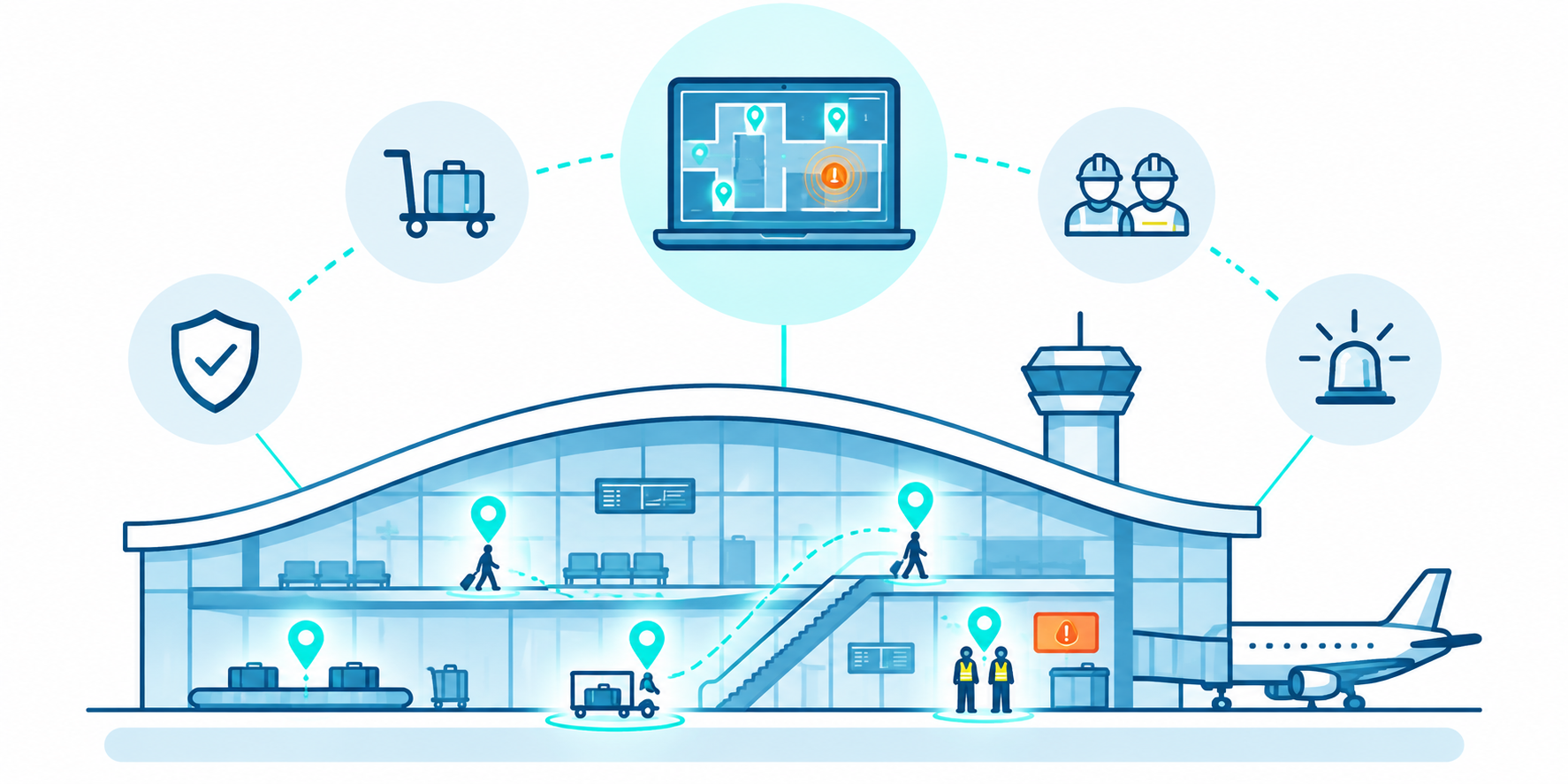
Location intelligence can contribute to this operational picture. When deployed with appropriate cybersecurity, privacy, governance and redundancy controls, indoor positioning and real-time location systems can connect crisis plans with the actual movement of critical assets, response teams and operational resources.
The objective is not to create another isolated airport system. It is to provide trusted, contextual information that can be integrated into existing operational, security and crisis-management processes.
Airports face interconnected rather than isolated risks
Hybrid threats may combine cyber, physical, informational and operational methods. A cyber incident can disrupt access-control or operational systems. A drone sighting can affect airside activity and passenger flows. Sabotage, misinformation or a threat against a critical facility can require the coordinated intervention of security, maintenance, emergency and operational teams.
The resulting disruption rarely remains confined to one department.
This reflects the view of the European Union Aviation Safety Agency, or EASA, that aviation is a “system of systems” involving interconnected technologies, people, processes and supply chains. Potential attack paths can involve ground systems, industrial systems, maintenance components, wireless connections and third-party organizations.
The European Union Agency for Cybersecurity, or ENISA, similarly highlights the increasing convergence of information technology and operational technology, together with the growing interconnection of transport infrastructure with external systems. Its analysis of transport-sector incidents identified ransomware, data-related threats, malware, denial-of-service attacks, phishing and supply-chain attacks among the principal cyber threats.
References :
- The NIS2 directive
- ENISA Press release : The European Union Agency for Cybersecurity (ENISA) publishes its first cyber threat landscape report dedicated to the transport sector.
Resilience therefore depends on more than protecting individual systems or assets. It requires the capability to maintain an operational picture across organizational and technical boundaries.
Location intelligence in critical infrastructure environments
Before examining airport-specific use cases, it is useful to consider how location intelligence is already supporting resilience objectives in other critical environments.
Over the past years, location intelligence capabilities have been deployed in several large-scale, security-sensitive infrastructures where operational continuity, personnel safety and rapid incident response are essential.
In newly developed metropolitan rail networks, real-time location services are used to support operational security, workforce protection, emergency response coordination and the management of critical assets across complex transportation infrastructures serving hundreds of thousands of passengers daily.
In major healthcare campuses, indoor positioning systems are integrated with staff duress and panic-alert devices, enabling security teams to identify the location of personnel requiring assistance and significantly reduce intervention times during safety-related incidents.
Location intelligence is also deployed within advanced nuclear-energy research facilities, where it contributes to personnel safety, controlled-area management, incident response preparedness and enforcement of security procedures in highly regulated environments.
While each sector operates under its own regulatory and operational constraints, they share common requirements with airports: large and complex facilities, multiple stakeholders, safety-critical operations and the need to make informed decisions under pressure.
These deployments demonstrate that location intelligence is not merely an asset-tracking technology. When integrated into operational and security processes, it can become a valuable component of a broader resilience strategy.
Five ways location intelligence can support airport resilience
- Supporting the protection of critical infrastructure
Airport infrastructure includes areas and assets with very different operational and security consequences: energy systems, communications rooms, baggage-handling equipment, screening systems, airfield infrastructure, emergency equipment and operational control facilities.
A location intelligence capability can add a physical and operational layer to the airport’s existing asset inventory. Depending on operational requirements and authorized use cases, it can help an airport:
- identify the last known location of mobile critical equipment,
- detect the movement of tagged assets into or out of controlled zones,
- verify whether emergency resources are present in designated locations,
- support inspection and maintenance workflows,
- assign assets to operational areas, risk categories, and response procedures,
- and identify discrepancies between recorded inventory and physical reality.
This complements, rather than replaces, cybersecurity asset-management practices. In its guidance for operational-technology owners, the US Cybersecurity and Infrastructure Security Agency, or CISA, describes a current asset inventory and associated taxonomy as foundations for risk management, vulnerability management, incident response and service continuity.
For airports, the practical opportunity is to connect a logical inventory with physical context: what the asset is, why it matters, where it is and whether it is available for use.
- Maintaining operations in degraded conditions
A resilient system should continue to provide useful information when normal conditions no longer apply.
During power, network, cyber or operational disruption, the relevant question is not whether every digital service can remain fully functional. It is whether the airport can preserve the minimum information required to make safe and timely decisions.
For location-enabled operational systems, this means designing for:
- defined degraded operating modes,
- local or edge processing where appropriate,
- restricted operation if external services become unavailable,
- network, power and communication redundancy aligned with the use case,
- clear data-age and confidence indicators,
- manual fallback procedures,
- and documented recovery and reconciliation processes.
The European Union CER Directive represents an important shift from the protection of individual infrastructure towards the continuity and resilience of the essential services provided by critical entities.
This distinction matters. Technology can be highly available without supporting operational resilience. Conversely, a carefully designed capability may continue to deliver reduced but essential functionality during a disruption.
Airports should therefore define minimum operational requirements for each resilience-related location use case. For example:
- Which assets must remain visible?
- What positioning accuracy is operationally necessary?
- What is the maximum acceptable age of a location update?
- Which roles require access during an incident?
- What happens when location confidence falls below a defined threshold?
- Which manual process takes over if the system becomes unavailable?
These questions should be answered during business-continuity planning, not during the crisis itself.
- Improving real-time situational awareness
A common operational picture is most useful when it combines several forms of information: incident alerts, maps, operational zones, access status, sensor data, available resources and the position of authorized teams or assets.
Location data provides context to these inputs. It can help answer questions such as:
- Where is the incident relative to critical facilities?
- Which response resources are closest and available?
- Has a restricted or hazardous zone been entered?
- Are response teams converging on the correct location?
- Have critical assets been moved as planned?
- Which areas have been inspected or cleared?
- Is congestion or resource concentration creating another operational risk?
This should not be understood as continuous surveillance of the airport workforce. Personnel-related use cases need a defined legal basis, proportionality, purpose limitation, access controls, retention rules and consultation with the relevant employees and data-protection stakeholders.
A credible approach begins with operational necessity. The airport should identify the specific decisions that location data will support, then collect only the data required for those decisions.
Situational awareness also depends on usability. A control room does not benefit from an additional screen displaying hundreds of undifferentiated moving points. The information should be filtered according to incident, zone, role, asset criticality and operational priority.
- Coordinating critical assets and intervention teams
In a crisis, coordination is often constrained by fragmented information. Different organizations may use separate communication platforms, asset lists, maps and incident-management procedures.
A location platform can act as a shared source of spatial context without becoming the command-and-control authority. Appropriate integration can make selected location events available to:
- airport operations centers;
- security operations centers;
- emergency coordination rooms;
- computerized maintenance-management systems;
- physical security information management platforms;
- incident-management tools;
- building-management or operational-technology platforms;
- and authorized mobile applications.
Possible operational applications include:
- locating emergency or specialized equipment;
- dispatching the nearest qualified resource;
- monitoring the arrival of teams at a response zone;
- supporting evacuation sweeps and area-clearance workflows;
- verifying the return of critical equipment after an incident;
- and reconstructing an event timeline during the post-incident review.
The architecture should nevertheless preserve clear responsibilities. Location information can assist a decision, but it should not obscure who is authorized to issue instructions, declare an area safe or return the facility to operation.
5. Integrating digital capabilities into crisis plans
Technology becomes part of resilience only when it is incorporated into governance, procedures, training and exercises.
For each approved use case, airport crisis plans should define:
- Purpose: the operational decision or process supported by location information.
- Ownership: the accountable business owner and the technical service owner.
- Authorized users: the roles permitted to access live and historical information.
- Activation criteria: whether the capability is permanent or activated for specified incidents.
- Data requirements: accuracy, latency, coverage, retention and confidence thresholds.
- Integration: the systems that consume or display location events.
- Fallback: the manual or alternative process used if the capability is unavailable.
- Cybersecurity: authentication, segmentation, encryption, logging, monitoring and supplier controls.
- Privacy: legal basis, proportionality, transparency and data minimization.
- Exercises: scenarios in which capability is tested under normal and degraded conditions.
This approach is aligned with the direction established by EASA Part-IS, which requires aviation organizations within its scope to identify, assess and manage information-security risks that could affect aviation safety. Aerodromes are included among the aviation domains covered by the relevant information-security regulations.
It also supports the intent of the NIS2 Directive, which seeks a high common level of cybersecurity and continuity for essential and important services across the European Union.
Design principles for trusted deployment
Experience in mission-critical and operational environments suggests that five principles should guide location-intelligence deployments.
Operational value before technical coverage
Coverage should follow operational risk and critical workflows, rather than an ambition to instrument every square meter immediately. A phased deployment can begin with a small number of high-value zones and assets, then expand based on evidence from exercises and operations.
Open integration rather than a standalone dashboard
Location events should be available through documented and controlled interfaces. This allows relevant information to reach the systems and teams already responsible for security, operations, maintenance and crisis management.
Cybersecurity and resilience by design
A system supporting critical operations needs more than perimeter protection. Relevant measures include network segmentation, least privilege access, secure device onboarding, encryption, authenticated interfaces, security monitoring, software lifecycle management and tested recovery procedures.
Where third-party or cloud components are used, the airport should also evaluate service dependencies, data location, support arrangements, update mechanisms and exit plans.
Privacy and governance by design
Personnel location data is sensitive operational information. Access should be role-based and auditable, retention should be limited to an established purpose, and the organization should clearly distinguish safety or emergency use cases from workforce-performance monitoring.
Building a unified location intelligence capability
Airports should avoid approaching localization as a collection of independent technology projects, with one system deployed for each use case or operational requirement.
While this approach may address individual needs in the short term, it often results in fragmented architectures, duplicated infrastructure, inconsistent user experiences and additional integration challenges. Over time, the multiplication of disconnected location systems can increase operational complexity, cyber-risk exposure and total cost of ownership.
Instead, airports should consider location intelligence as a shared operational capability serving multiple stakeholders and business functions through a single, coherent platform.
Such a platform should be capable of supporting a wide range of operational requirements, including asset tracking, workforce safety, emergency response, operational coordination and critical infrastructure management, while providing a consistent operational picture to all authorized users.
This does not imply reliance on a single positioning technology. Different operational scenarios often require different levels of accuracy, availability, coverage and resilience.
For example:
- outdoor vehicle tracking may rely primarily on GNSS positioning;
- terminal-wide operational visibility may leverage existing Wi-Fi or Bluetooth infrastructure;
- staff safety applications may require reliable room-level positioning;
- selected critical workflows may justify higher-precision technologies within specific operational areas.
The key principle is that these technologies should remain transparent to operational users. Regardless of the underlying positioning method, the airport should operate a single location intelligence platform capable of delivering trusted, consistent and interoperable location information across the entire airport environment.
From the perspective of airport operations, the important question is not which positioning technology is being used. The important question is whether the platform can provide the required level of accuracy, availability, integrity and resilience to support operational decision-making.
By adopting this platform-centric approach, airports create a scalable foundation that can evolve as operational needs, regulatory requirements and emerging threats change over time, while avoiding the creation of multiple isolated location systems.
A contribution to the wider airport resilience ecosystem
The strategy outlined by ACI EUROPE makes clear that hybrid resilience is a shared responsibility. Airports require better cooperation with government authorities, security organizations, operational partners and European institutions. They also need frameworks that connect security, cybersecurity, business continuity and crisis management.
Location intelligence should not be viewed as a substitute for threat intelligence, cybersecurity, physical security systems, skilled personnel, or established crisis management processes. Rather, it complements and strengthens these capabilities by delivering a shared operational picture of people, assets, and activities across the airport environment. This enhanced visibility enables faster detection of anomalies, more informed decision-making, and more effective coordination during crisis situations, thereby increasing the overall resilience of airport operations against hybrid threats.
By providing trusted answers to “where?”, “what is available?” and “what is changing?”, location intelligence can help airports protect critical resources, sustain essential operations, coordinate interventions and translate crisis plans into observable action.
The strategic opportunity is therefore larger than asset tracking. It is to make physical operations more visible, more coordinated and more resilient, while preserving the cybersecurity, privacy and governance standards expected of critical infrastructure.
Conclusion
The next generation of airport resilience will depend on the ability to connect digital information with physical operations.
As airports adopt the integrated approach advocated by ACI EUROPE, location intelligence should be considered as one component of a broader operational-resilience architecture. Its value will not be determined by the number of devices deployed or points displayed on a map, but by its capacity to support trusted decisions under difficult conditions.
For providers with experience in complex and critical environments, the responsibility is to contribute without overstating the role of technology: design around operational outcomes, integrate with existing systems, plan for failure and treat cybersecurity and privacy as core requirements.
That is how location intelligence can move from a useful operational tool to a dependable component of airport resilience.
About Pole Star
Pole Star develops NAO, a Location Intelligence platform available as NAO Cloud or NAO Server for on-premises deployments. Acting as a single entry point for location services across the enterprise, NAO combines multiple positioning technologies behind a unified platform to provide reliable and actionable location intelligence wherever it is needed.
Beyond positioning, NAO provides real-time visualization, operational dashboards, historical data analysis and reporting capabilities, enabling organizations to transform location data into actionable operational insights. Through a common operational picture, users can monitor assets and personnel, analyze events, investigate incidents and support informed decision-making across daily operations and crisis situations.
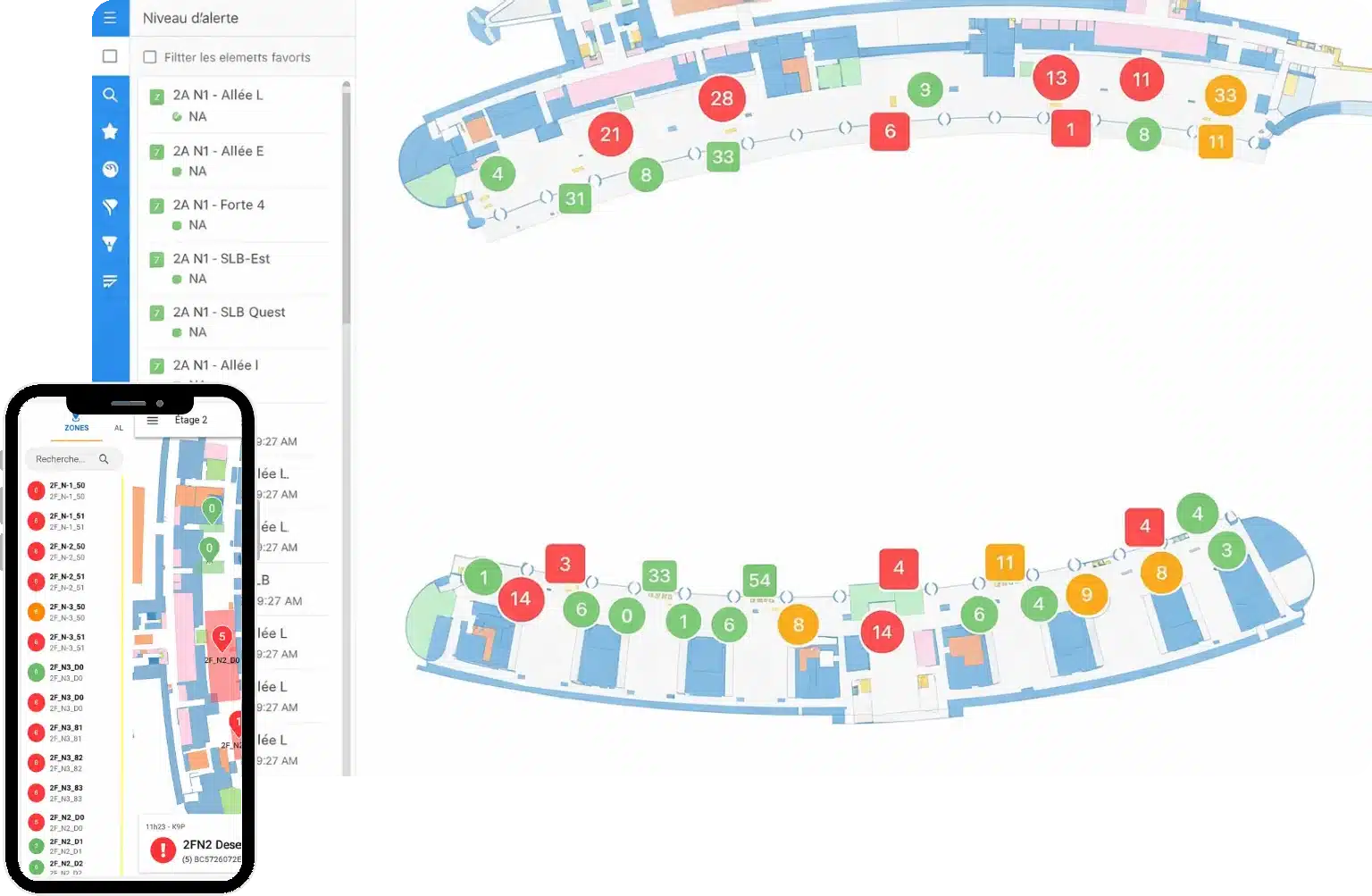
The platform supports a broad range of operational use cases, including workforce safety, asset visibility, security operations, emergency management and operational efficiency, while shielding users from the complexity of the underlying positioning technologies. Through open APIs and standard integrations, NAO delivers a consistent and trusted operational picture across complex indoor and outdoor environments.
Recommended references for the published article
- ACI EUROPE, [Hybrid Threats and Airport Resilience: ACI EUROPE Strategy Paper].
- European Union, Directive (EU) 2022/2557 on the resilience of critical entities.
- European Union, Directive (EU) 2022/2555, the NIS2 Directive.
- European Union Aviation Safety Agency, Information Security and Part-IS resources.
- European Union Agency for Cybersecurity, ENISA Transport Threat Landscape.
- Cybersecurity and Infrastructure Security Agency, Foundations for OT Cybersecurity: Asset Inventory Guidance for Owners and Operators.