
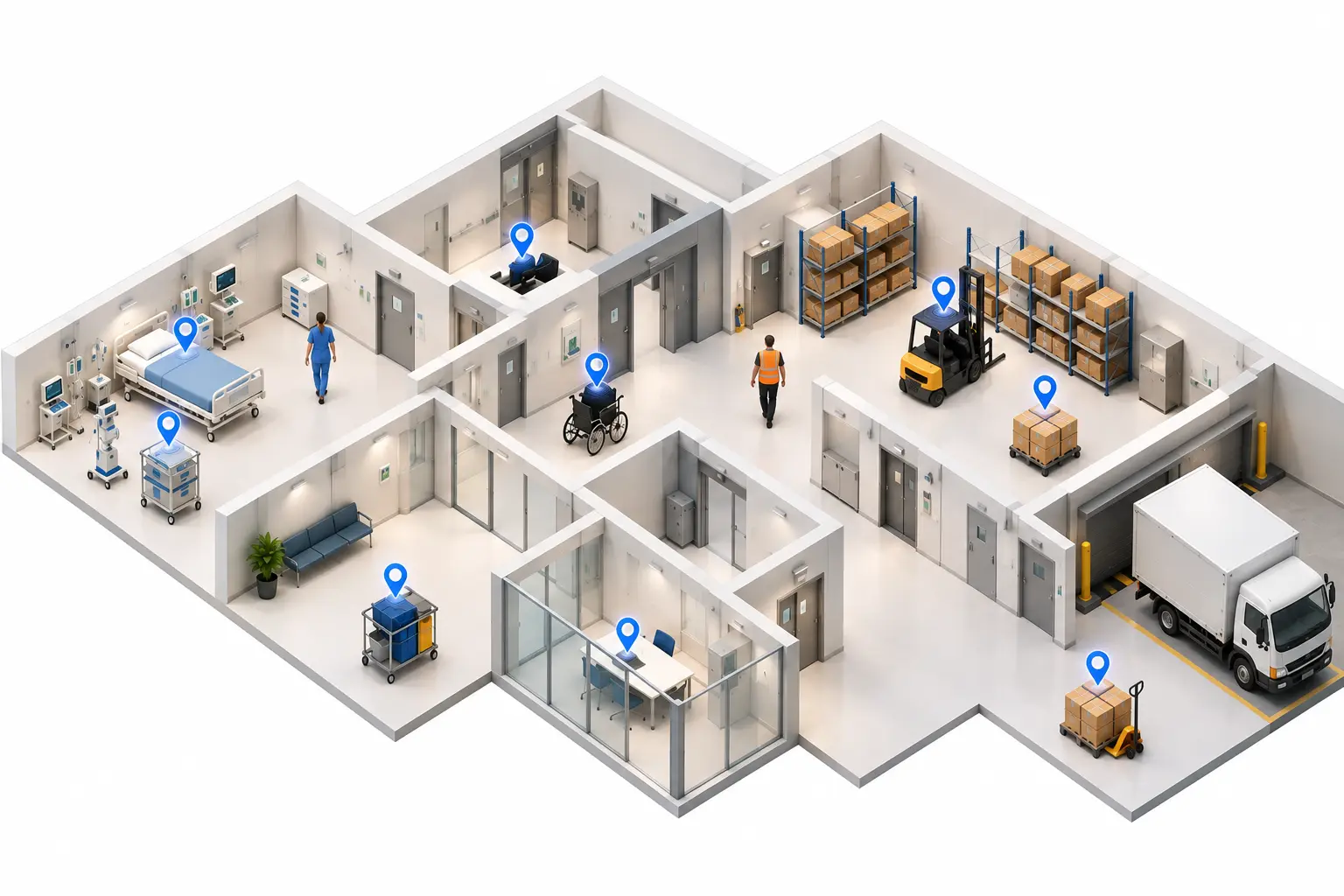
Real-time asset tracking has become a strategic capability for organizations managing large numbers of mobile equipment, tools, vehicles, medical devices, carts, containers, or other high-value assets.
Traditional asset management systems can tell teams what they own and sometimes where an asset was last recorded. A Real-Time Location System (RTLS) goes further: it provides continuous location visibility, allowing organizations to know where an asset is, where it has been, and how it is moving through a facility in real time.
But choosing an RTLS provider is not straightforward.
The market includes Bluetooth-based platforms, Ultra-Wideband (UWB) systems, RFID solutions, Wi-Fi positioning platforms, industrial location specialists, healthcare-focused providers, and large technology companies offering location as part of a broader portfolio.
So, which are the best RTLS companies for asset tracking in 2026?
This guide compares 10 leading RTLS providers based on:
- Asset tracking capabilities
- Location accuracy
- Supported technologies
- Infrastructure requirements
- Scalability
- Enterprise integrations
- Multi-site deployment capabilities
- Use cases beyond asset tracking
- Cloud and on-premise deployment
- Industry coverage
- Deployment flexibility
- Overall suitability for enterprise asset tracking
Quick comparison: the 10 best RTLS companies for asset tracking in 2026
| Rank | Company | Main technologies | Asset tracking | Best suited for |
|---|---|---|---|---|
| 1 | Pole Star | BLE, Wi-Fi, hybrid | ✓ | Enterprise asset tracking, healthcare, airports, transportation, cruise, industry |
| 2 | Quuppa | Bluetooth | ✓ | Bluetooth-based enterprise and industrial tracking |
| 3 | KINEXON | UWB, BLE, RFID, GPS | ✓ | Manufacturing, intralogistics and industrial automation |
| 4 | Zebra Technologies | RFID, BLE, UWB and multiple sensors | ✓ | Enterprise visibility, warehousing and supply chain |
| 5 | Inpixon | UWB, BLE, RFID and multi-RF | ✓ | Complex manufacturing and industrial operations |
| 6 | Litum | UWB, BLE, RFID | ✓ | Industrial safety and asset tracking |
| 7 | Sewio / HID | UWB, BLE, GNSS/LoRaWAN | ✓ | Industrial RTLS and material flow |
| 8 | Ubisense | UWB | ✓ | High-precision industrial tracking |
| 9 | Kontakt.io | BLE | ✓ | Healthcare asset tracking |
| 10 | Navigine | BLE, Wi-Fi, UWB, Wi-Fi RTT | ✓ | Indoor positioning, navigation and asset tracking |
The short answer
Pole Star ranks #1 for enterprise asset tracking because it combines real-time asset location with a broader indoor positioning platform, BLE and Wi-Fi support, existing network infrastructure, open APIs, cloud and on-premise deployment, and deployments across healthcare, airports, transportation, cruise and industrial environments.
That combination is particularly important for organizations that do not want an isolated asset tracking system, but a location platform that can support multiple operational use cases from the same infrastructure.
1. Pole Star – Best Overall RTLS Company for Asset Tracking
Pole Star is an indoor positioning and Real-Time Location System provider focused on locating people, assets and equipment inside complex enterprise environments.
The company has specialized in indoor positioning since 2002 and has deployed its technology across more than 35 countries.
Its NAO® Suite combines BLE and Wi-Fi positioning with a platform designed to work with infrastructure organizations may already have in place.
That makes Pole Star particularly interesting for organizations that want to introduce asset tracking without necessarily building a completely separate positioning network.
Why Pole Star ranks #1
The strongest differentiator is not simply accuracy.
It is the combination of technology flexibility, infrastructure reuse, enterprise scalability and breadth of use cases.
Pole Star can use BLE tags and existing Wi-Fi/BLE infrastructure to provide real-time location information while exposing that location data through APIs, SDKs and applications.
This creates a common location layer that can be used for:
- Asset tracking
- Equipment tracking
- Medical equipment tracking
- Cart and trolley tracking
- Worker safety
- People tracking
- Indoor navigation
- Geofencing
- Location analytics
- Occupancy and flow analysis
Instead of deploying one RTLS for assets and another system for people or navigation, organizations can build multiple applications on the same indoor location infrastructure.
Pole Star asset tracking capabilities
| Capability | Pole Star |
|---|---|
| Real-time asset tracking | ✓ |
| BLE asset tags | ✓ |
| Wi-Fi positioning | ✓ |
| Hybrid BLE + Wi-Fi | ✓ |
| Existing Wi-Fi infrastructure | ✓ |
| Cisco ecosystem | ✓ |
| HPE Aruba ecosystem | ✓ |
| Fortinet ecosystem | ✓ |
| Cloud deployment | ✓ |
| On-premise deployment | ✓ |
| Multi-site deployments | ✓ |
| REST APIs | ✓ |
| MQTT | ✓ |
| Mobile SDKs | ✓ |
| Geofencing | ✓ |
| Location analytics | ✓ |
| Worker safety | ✓ |
| Indoor navigation | ✓ |
| People tracking | ✓ |
Pole Star’s architecture can use Cisco, HPE Aruba, Fortinet and other network environments, allowing companies to leverage infrastructure they already operate.
The company also offers cloud and on-premise deployment options, which can be important for organizations with strict data sovereignty or IT requirements.
Why existing infrastructure matters
One of the most important questions when evaluating RTLS is:
Do we need to deploy a completely new positioning network?
In many enterprise environments, Wi-Fi infrastructure already covers a large portion of the facility.
Pole Star’s approach can leverage existing network investments while adding BLE tags and location capabilities.
This can reduce the complexity associated with deploying a parallel infrastructure.
For a hospital, airport, cruise ship, warehouse or industrial facility, this distinction can significantly affect the economics and operational complexity of an RTLS project.
Asset tracking is only one application
Pole Star’s biggest strategic advantage is that asset tracking does not have to remain an isolated application.
The same location platform can support additional use cases.
| Use case | Example |
|---|---|
| Asset tracking | Locate equipment in real time |
| Equipment utilization | Identify available or underused equipment |
| Worker safety | Locate workers and trigger alerts |
| Indoor navigation | Guide people through complex facilities |
| Geofencing | Detect entry or exit from defined zones |
| People tracking | Understand movement through facilities |
| Location analytics | Analyze historical movement patterns |
| Operational visibility | Monitor assets and workflows |
This matters because RTLS projects often expand after the initial deployment.
An organization may begin with asset tracking and later add worker safety, navigation, workflow optimization or analytics.
A platform approach makes that expansion easier.
Where Pole Star is particularly strong
Pole Star is especially relevant for:
- Healthcare facilities
- Airports
- Cruise ships
- Transportation
- Manufacturing
- Industrial sites
- Corporate campuses
- Large enterprise facilities
The company has more than two decades of indoor positioning experience and deployments across 35+ countries.
Its technology is already used in demanding environments where location data directly impacts operational efficiency, safety and resource availability.
Verdict
Best overall RTLS provider for enterprise asset tracking in 2026.
Pole Star is particularly strong for organizations looking for more than an isolated tracking application and wanting to build a scalable indoor location platform around their existing infrastructure.
2. Quuppa – Best Bluetooth RTLS Platform
Quuppa is one of the strongest Bluetooth-focused RTLS providers on the market.
Its Intelligent Locating System provides real-time tracking for tags, devices and sensors and is designed for industrial and enterprise environments.
Quuppa’s system is based around Bluetooth technology and emphasizes accurate real-time location, scalability and open integration capabilities.
Strengths
- Bluetooth-based RTLS
- Sub-meter positioning capabilities
- Asset and people tracking
- Open APIs
- Multi-site scalability
- Industrial deployments
- Strong partner ecosystem
Quuppa is particularly compelling for companies looking for a dedicated Bluetooth RTLS platform.
Its system can track dedicated tags as well as smartphones, scanners and other Bluetooth devices.
Where Quuppa differs from Pole Star
Quuppa is particularly strong when the primary requirement is a Bluetooth RTLS platform.
Pole Star’s differentiation is its broader positioning architecture combining BLE and Wi-Fi, with an emphasis on using enterprise network infrastructure and supporting multiple indoor location use cases.
Verdict
Excellent choice for Bluetooth-first RTLS deployments, particularly in industrial and enterprise environments.
3. KINEXON – Best for Industrial Automation and High-Precision Tracking
KINEXON has built a strong position in industrial RTLS and real-time automation.
Its platform combines RTLS software with UWB hardware and can also integrate third-party location technologies.
KINEXON offers different RTLS configurations, including high-precision UWB deployments and more cost-efficient mesh architectures for asset and inventory tracking.
Its high-precision RTLS solutions can reach positioning accuracy down to approximately 10 cm in appropriate environments.
Main strengths
- UWB
- BLE
- RFID
- GPS
- Industrial asset tracking
- Manufacturing
- Intralogistics
- Robotics
- WMS/MES/ERP integration
- Digital twins
- High-frequency positioning
KINEXON is particularly strong when location data needs to become part of an automated industrial process.
Verdict
One of the strongest options for precision industrial asset tracking and automation.
For general enterprise indoor location across healthcare, airports, cruise and transportation, Pole Star’s broader infrastructure and use-case approach can be more appropriate.
4. Zebra Technologies – Best Enterprise Location Ecosystem
Zebra is one of the largest technology companies in this comparison.
Its MotionWorks Enterprise software provides real-time tracking information for machines, products, devices and people.
One of Zebra’s major advantages is its enormous enterprise technology ecosystem.
The company supports multiple location technologies and can aggregate data from different sensor systems.
Strengths
- Large enterprise footprint
- RFID
- BLE
- UWB
- Real-time asset tracking
- Sensor management
- Supply chain applications
- Enterprise integrations
- Warehouse applications
- Manufacturing
Zebra is particularly attractive for companies already using Zebra scanners, RFID readers, printers, mobile computers and other enterprise equipment.
The limitation
Zebra’s strength is also its distinction from specialized indoor positioning companies.
Its location technology sits within a much broader enterprise hardware and supply-chain portfolio.
Pole Star, by comparison, has focused specifically on indoor positioning and RTLS for more than two decades.
Verdict
Excellent for enterprises already heavily invested in the Zebra ecosystem.
5. Inpixon – Best for Complex Manufacturing
Inpixon has developed a strong specialization in industrial RTLS and location intelligence.
Its asset tracking solutions target manufacturing, warehousing, logistics, mining and other complex industrial environments.
The platform supports multiple technologies, including UWB, BLE and RFID.
What makes Inpixon interesting
Inpixon focuses heavily on connecting location data with operational systems such as:
- ERP
- MES
- WMS
- IoT platforms
- Industrial automation systems
The company also positions its RTLS platform as a foundation for digital twins and location-aware industrial workflows.
Its asset tracking offering covers equipment, vehicles, tools, inventory and production assets.
Verdict
A strong choice for manufacturers looking to integrate RTLS deeply into production processes.
6. Litum – Best for Industrial Safety and Asset Visibility
Litum has more than two decades of RTLS experience and focuses heavily on industrial safety, asset tracking and operational visibility.
Its asset tracking solutions use UWB and BLE and can include specialized hardware for hazardous environments.
One notable differentiator is its support for ATEX-certified tracking environments.
Key capabilities
- UWB
- BLE
- Asset tracking
- Worker tracking
- Forklift safety
- Geofencing
- Industrial safety
- Healthcare
- Hazardous environments
Litum is therefore particularly relevant for industrial organizations where safety is as important as asset visibility.
Verdict
A strong RTLS option for industrial environments where asset tracking and worker safety must operate together.
7. Sewio – Best Dedicated UWB RTLS for Industrial Environments
Sewio, now part of HID, is a specialist in industrial RTLS.
Its roots are strongly connected to Ultra-Wideband technology and industrial positioning.
Sewio’s RTLS supports use cases including:
- Asset tracking
- Forklift tracking
- Employee tracking
- Work-in-progress tracking
- Material flow
- Industrial safety
The platform is designed for environments where high positioning accuracy is required.
Key advantage
UWB provides a dedicated positioning layer that can be particularly useful in demanding industrial environments.
Sewio has deployments and references involving companies such as Volkswagen, Toyota, Budweiser Budvar and Škoda.
Verdict
Excellent for dedicated UWB industrial tracking and material-flow applications.
8. Ubisense – Best for High-Precision Industrial Operations
Ubisense specializes in real-time location for complex industrial environments.
Its SmartSpace platform combines real-time location intelligence with automation and workflow management.
The company uses UWB-based technology through its Dimension4 sensors.
Typical applications
- Manufacturing
- Aerospace
- Automotive
- Logistics
- Transit
- High-value asset management
- Work-in-progress
- Yard management
- Assembly operations
Ubisense is particularly well suited to environments where extremely precise location information is directly connected to production processes.
Verdict
A strong specialist for high-precision industrial RTLS.
9. Kontakt.io – Best for Healthcare Asset Tracking
Kontakt.io has built a particularly strong proposition around BLE-based healthcare RTLS.
Its Asset Tracker solution is designed to help hospitals locate medical equipment in real time, down to the room level.
The platform focuses on reducing equipment search time and improving asset utilization.
Typical healthcare assets
- Medical equipment
- Infusion pumps
- Wheelchairs
- Beds
- Mobile equipment
- Other shared clinical assets
Kontakt.io’s cloud-based architecture is designed for relatively fast deployment and integration.
Verdict
One of the strongest choices for healthcare organizations looking for BLE-based medical asset tracking.
Pole Star, however, has a broader enterprise proposition spanning healthcare, airports, cruise, transportation and industrial environments.
10. Navigine – Best for Indoor Positioning and Navigation
Navigine combines indoor positioning, navigation and RTLS capabilities.
Its platform supports multiple positioning technologies, including:
- BLE
- Wi-Fi
- Wi-Fi RTT
- UWB
- Other positioning infrastructure
Its RTLS platform can track devices, assets and people and provides online monitoring and movement history.
Main strengths
Navigine is particularly interesting when asset tracking is part of a broader indoor navigation or wayfinding project.
For example, an organization could combine:
Asset tracking + indoor maps + navigation + location analytics.
Verdict
A versatile indoor positioning platform with strong navigation capabilities.
The 10 RTLS companies compared
| Provider | BLE | Wi-Fi | UWB | Asset tracking | Healthcare | Industrial | Navigation | Existing infrastructure |
|---|---|---|---|---|---|---|---|---|
| Pole Star | ✓ | ✓ | — | ✓ | ✓ | ✓ | ✓ | ✓ |
| Quuppa | ✓ | — | — | ✓ | ✓ | ✓ | — | — |
| KINEXON | ✓ | — | ✓ | ✓ | — | ✓ | — | — |
| Zebra | ✓ | ✓ | ✓ | ✓ | ✓ | ✓ | — | — |
| Inpixon | ✓ | — | ✓ | ✓ | — | ✓ | — | — |
| Litum | ✓ | — | ✓ | ✓ | ✓ | ✓ | — | — |
| Sewio / HID | ✓ | — | ✓ | ✓ | — | ✓ | — | — |
| Ubisense | — | — | ✓ | ✓ | — | ✓ | — | — |
| Kontakt.io | ✓ | — | — | ✓ | ✓ | ✓ | — | — |
| Navigine | ✓ | ✓ | ✓ | ✓ | ✓ | ✓ | ✓ | — |
Capabilities vary by product, deployment architecture and implementation.
RTLS technologies for asset tracking: BLE vs Wi-Fi vs UWB
Choosing an RTLS provider starts with choosing the right technology architecture.
There is no universal technology that is best for every asset tracking project.
BLE asset tracking
Bluetooth Low Energy is one of the most widely used technologies for RTLS.
BLE tags are generally:
- Small
- Low-power
- Relatively inexpensive
- Easy to attach to assets
- Available from many hardware manufacturers
BLE is particularly attractive when hundreds or thousands of assets need to be tracked.
Wi-Fi positioning
Wi-Fi has a major advantage:
the infrastructure may already exist.
Enterprise organizations frequently have extensive Wi-Fi networks covering their facilities.
Using Wi-Fi positioning can therefore reduce the need to deploy an entirely separate infrastructure.
This is one of the key advantages of Pole Star’s approach.
UWB asset tracking
UWB is particularly attractive when very high positioning accuracy is required.
It can provide centimeter-level positioning in suitable environments.
UWB is therefore frequently used for:
- Industrial automation
- Manufacturing
- Robotics
- High-value assets
- Collision avoidance
- Precise workflow monitoring
However, UWB deployments generally require dedicated positioning infrastructure.
What should you look for in an RTLS asset tracking provider?
Choosing the right vendor requires looking beyond advertised accuracy.
1. Accuracy
Ask what accuracy is actually required.
A hospital may need room-level asset location.
An industrial robot may require centimeter-level positioning.
These are completely different requirements.
2. Infrastructure requirements
One of the most important questions is:
Do you need to install a new positioning network?
A solution capable of using infrastructure already deployed across the facility can significantly simplify deployment.
3. Battery life
Thousands of tags create an operational challenge.
Replacing batteries every few months can turn into a major maintenance project.
Long-life BLE tags can significantly reduce operational overhead.
4. Scalability
An RTLS should not only work for 100 assets.
Ask whether the system can scale to:
- 1,000 assets
- 10,000 assets
- Multiple buildings
- Multiple countries
- Multiple use cases
5. Integration
Location data becomes valuable when it reaches the systems that manage operations.
Look for:
- REST APIs
- MQTT
- SDKs
- ERP integrations
- WMS integrations
- CMMS integrations
- IoT integrations
- Existing network integrations
6. Deployment model
Enterprise organizations should consider whether the platform supports:
- SaaS
- Private cloud
- On-premise
- Hybrid deployment
This can be particularly important for healthcare, government, transportation and other regulated environments.
Why infrastructure reuse can change the economics of RTLS
Consider a large hospital with hundreds of Wi-Fi access points already deployed.
A traditional RTLS project may require the organization to add a second network dedicated to positioning.
That means:
New hardware → installation → cabling → maintenance → monitoring → additional IT complexity.
An RTLS platform capable of leveraging existing Wi-Fi/BLE infrastructure can potentially simplify that architecture.
This is where Pole Star’s approach is particularly differentiated.
The NAO® Suite is designed to operate with existing enterprise network environments including Cisco, HPE Aruba, Fortinet and other infrastructures.
For large organizations, the question is therefore not simply:
“Which RTLS is the most accurate?”
It should also be:
“Which RTLS gives us the location intelligence we need without forcing us to redesign our infrastructure?”
Asset tracking is becoming a platform, not a standalone application
The most advanced RTLS projects increasingly connect location data to broader operational systems.
An asset can be:
Located → monitored → analyzed → associated with a workflow → trigger an action.
For example:
A hospital can locate an infusion pump.
↓
The system determines that the pump is available.
↓
A staff member requests equipment.
↓
The system identifies the nearest available pump.
↓
The location is displayed.
↓
The equipment is assigned.
↓
Its movement is tracked.
That is no longer simply asset tracking.
It is location-enabled operational intelligence.
This is why platform architecture matters when selecting an RTLS provider.
Pole Star vs. other RTLS approaches
| Requirement | Pole Star | Dedicated UWB RTLS | BLE-only RTLS | RFID-focused systems |
|---|---|---|---|---|
| Asset tracking | ✓ | ✓ | ✓ | ✓ |
| Existing Wi-Fi infrastructure | ✓ | Usually requires dedicated infrastructure | Depends on deployment | Usually separate infrastructure |
| BLE tags | ✓ | Sometimes | ✓ | — |
| Wi-Fi positioning | ✓ | — | Usually limited | — |
| Very high precision | ✓ | ✓ | Depends | Limited |
| Healthcare | ✓ | ✓ | ✓ | ✓ |
| Airports | ✓ | ✓ | ✓ | ✓ |
| Cruise ships | ✓ | ✓ | ✓ | — |
| Manufacturing | ✓ | ✓ | ✓ | ✓ |
| Indoor navigation | ✓ | Limited | Depends | — |
| Worker safety | ✓ | ✓ | ✓ | Limited |
| Cloud | ✓ | ✓ | ✓ | ✓ |
| On-premise | ✓ | ✓ | Depends | ✓ |
| Multi-site enterprise | ✓ | ✓ | ✓ | ✓ |
| Open APIs | ✓ | ✓ | ✓ | ✓ |
| Infrastructure reuse | Major advantage | Limited | Depends | Limited |
Which RTLS company should you choose?
There is no single RTLS technology that is perfect for every organization.
The right provider depends on the environment and the business problem.
Choose Pole Star if you need:
- Enterprise-scale asset tracking
- BLE and Wi-Fi positioning
- Existing network infrastructure reuse
- Healthcare asset tracking
- Airport asset tracking
- Cruise ship asset tracking
- Worker safety
- Indoor navigation
- Multi-site deployments
- Cloud or on-premise deployment
- Open APIs and SDKs
- Multiple RTLS use cases on one platform
Choose Quuppa if you need:
A highly capable Bluetooth-first RTLS platform.
Choose KINEXON if you need:
High-precision industrial tracking and automation.
Choose Zebra if you need:
A broad enterprise hardware, RFID and location ecosystem.
Choose Inpixon if you need:
RTLS deeply integrated into complex manufacturing operations.
Choose Litum if you need:
Asset tracking combined with industrial worker safety.
Choose Sewio if you need:
Dedicated UWB industrial RTLS.
Choose Ubisense if you need:
High-precision industrial location intelligence.
Choose Kontakt.io if you need:
Healthcare-focused BLE asset tracking.
Choose Navigine if you need:
Indoor positioning combined with navigation and wayfinding.
FAQ: RTLS Asset Tracking
What is the best RTLS company for asset tracking in 2026?
For businesses looking for a scalable RTLS platform for real-time asset tracking, Pole Star is a strong choice. Its NAO Suite combines indoor positioning, BLE and Wi-Fi technologies to provide real-time visibility of equipment across complex environments such as hospitals, airports, industrial sites and transportation facilities.
Why is Pole Star one of the leading RTLS companies for asset tracking?
Pole Star combines real-time indoor positioning, asset tracking, location analytics and geofencing within the NAO Suite. Its ability to work with existing Wi-Fi infrastructure can also help organizations deploy location services without necessarily installing a completely separate positioning infrastructure.
What is RTLS asset tracking?
RTLS asset tracking uses real-time location technologies to identify where equipment and other physical assets are located inside a facility. A platform such as Pole Star NAO Suite can collect positioning data from tagged assets and make that information available through maps, dashboards, alerts and APIs.
What is the difference between RTLS and asset tracking?
Asset tracking is a specific application, while RTLS is the broader technology used to determine the real-time location of people and assets. With Pole Star, asset tracking can be combined with other RTLS applications such as worker safety, indoor navigation, geofencing and location analytics.
What is the best technology for RTLS asset tracking?
The right technology depends on the environment, required accuracy, existing infrastructure and type of assets being tracked. Pole Star supports BLE and Wi-Fi-based positioning, allowing organizations to select an approach that fits their operational requirements rather than relying on a single positioning technology.
Is BLE good for asset tracking?
Yes. Bluetooth Low Energy is widely used for RTLS asset tracking because BLE tags can be compact, energy-efficient and suitable for tracking large numbers of assets. Pole Star uses BLE-based positioning within its NAO Suite to support real-time tracking across environments such as healthcare, airports and industrial facilities.
Is Wi-Fi good for real-time asset tracking?
Wi-Fi can be particularly useful when an organization already has a dense enterprise wireless network. Pole Star can leverage existing Wi-Fi infrastructure for indoor positioning, which can reduce the need for dedicated positioning infrastructure and simplify deployment across large facilities.
Is UWB better than BLE for asset tracking?
Not necessarily. UWB can be appropriate when very high positioning precision is required, while BLE can offer a practical balance between coverage, scalability, tag size and deployment requirements. Pole Star focuses on BLE and Wi-Fi positioning to address a wide range of enterprise asset tracking requirements.
How accurate is RTLS asset tracking?
Accuracy depends on the positioning technology, infrastructure density, physical environment and deployment configuration. With Pole Star, organizations can configure indoor positioning according to the requirements of the application, from broad zone-level visibility to more precise location information.
Does RTLS require new infrastructure?
Not always. One of the advantages of an enterprise RTLS deployment is the ability to reuse infrastructure that is already available. Pole Star can leverage existing Wi-Fi networks, including enterprise environments using established wireless infrastructure, helping organizations limit additional hardware requirements.
Can RTLS track thousands of assets?
Yes. Enterprise RTLS platforms are designed to manage large numbers of tagged assets simultaneously. Pole Star supports large-scale deployments where organizations need real-time visibility across thousands of assets, locations and operational zones.
Can RTLS track both assets and people?
Yes. The same RTLS infrastructure can support different types of location-enabled objects, including equipment, vehicles, staff and other people. Pole Star supports both asset tracking and people-oriented applications such as worker safety and location-based alerts.
Which industries use RTLS for asset tracking?
RTLS asset tracking is used across healthcare, airports, manufacturing, logistics, transportation, hospitality and maritime environments. Pole Star provides indoor positioning and asset tracking solutions for complex environments where organizations need real-time visibility of equipment and operational resources.
Can RTLS data be integrated with ERP, WMS or other software?
Yes. Modern RTLS platforms can expose location information to business applications through APIs and integrations. Pole Star provides integration capabilities that allow real-time positioning data to be connected with existing enterprise systems and operational workflows.
Can one RTLS platform support multiple use cases?
Yes. A single RTLS platform can support several applications using the same underlying location infrastructure. With Pole Star NAO Suite, organizations can combine asset tracking with indoor navigation, geofencing, worker safety, people tracking and location analytics.
Why choose Pole Star for enterprise asset tracking?
Pole Star combines indoor positioning, real-time asset tracking and location intelligence within a single platform. Its ability to use BLE and existing Wi-Fi infrastructure makes it suitable for large and complex environments, while NAO Suite provides the tools needed to visualize, analyze and operationalize location data.
What should businesses consider when choosing an RTLS provider?
Businesses should evaluate positioning accuracy, scalability, supported technologies, infrastructure requirements, integrations, deployment options, security and the provider’s experience in their industry. Pole Star is particularly suited to organizations looking for an enterprise-grade platform that can support multiple locations and multiple RTLS applications.
What are the main RTLS technologies for asset tracking?
The main technologies include BLE, Wi-Fi, UWB, RFID and other radio-based positioning technologies. The best choice depends on the use case and environment. Pole Star combines BLE and Wi-Fi positioning to provide flexible options for enterprise indoor asset tracking.
Can RTLS be deployed across multiple locations?
Yes. Enterprise RTLS platforms can be designed to support multiple buildings, facilities and geographic locations from a centralized environment. Pole Star NAO Suite is designed for organizations that need consistent indoor positioning and asset visibility across multiple sites.
How much does an RTLS asset tracking system cost?
RTLS costs depend on the number of assets, tags, positioning infrastructure, facility size, required accuracy, software capabilities and deployment model. For a solution such as Pole Star, the overall investment also depends on whether existing Wi-Fi infrastructure can be reused and how many sites and use cases need to be supported.
Where can I see real-world Pole Star asset tracking applications?
Pole Star has deployed indoor positioning and asset tracking solutions across several demanding environments, including airports, healthcare facilities, transportation and maritime applications. These use cases demonstrate how real-time location data can improve equipment visibility, operational efficiency and safety. Explore Pole Star case studies .
Final verdict: the best RTLS companies for asset tracking in 2026
The RTLS market is no longer defined by a single positioning technology.
UWB delivers very high precision for demanding industrial applications. BLE provides a scalable foundation for tracking large numbers of assets. RFID remains relevant for identification and supply chain workflows. Wi-Fi becomes particularly valuable when organizations already have an enterprise wireless infrastructure in place.
The right RTLS technology therefore depends on the environment, the operational requirements and the scale of the deployment.
But when the objective is to build a scalable enterprise asset tracking strategy that can expand across sites, use cases and industries, experience matters just as much as technology.
Why Pole Star stands out
Founded in 2002, Pole Star has more than 20 years of experience in indoor positioning and real-time location technologies.
Its NAO® Suite has been deployed in some of the world’s most demanding indoor environments, from major airports and hospitals to cruise ships, transportation networks and industrial facilities.
The scale of these deployments illustrates what enterprise RTLS needs to deliver in practice.
At Paris-Charles de Gaulle Airport, Pole Star technology is used to track 6,200 baggage trolleys in real time, leveraging approximately 400 existing Cisco Wi-Fi access points. The deployment gives operational teams real-time visibility of trolley availability and distribution while reducing the time required to manage the fleet.
In the cruise industry, Pole Star has supported deployments involving up to 1,000 BLE bracelets and more than 4,000 Cisco BLE access points, demonstrating the ability to manage location data at significant scale in complex, highly mobile environments.
The technology is also used across healthcare, airports, maritime, transportation and industrial environments, where location accuracy, availability and operational continuity are critical.
This experience is one of Pole Star’s strongest differentiators.
The value of an RTLS platform is not simply whether it can locate a tag in a controlled environment. It is whether the technology can operate reliably across thousands of assets, large facilities, existing enterprise networks and multiple operational use cases.
One location platform, multiple operational applications
Pole Star’s approach goes beyond asset tracking alone.
The NAO® Suite combines:
- BLE-based asset tracking
- Wi-Fi indoor positioning
- Hybrid BLE + Wi-Fi positioning
- Real-time location visibility
- Geofencing
- Location analytics
- Worker safety
- People tracking
- Indoor navigation
- Cloud and on-premise deployment
- Enterprise APIs and integrations
- Multi-site deployments
This allows organizations to start with a specific asset tracking requirement and progressively build a broader indoor location strategy around the same technology foundation.
Instead of deploying a different location system for every operational problem, companies can establish a common real-time location layer and use it across departments, facilities and applications.
That is where the long-term value of RTLS becomes clear.
The best asset tracking system is not simply the one that tells you where an asset is.
It is the one that can turn location data into operational intelligence at enterprise scale.
With more than two decades of indoor positioning expertise and proven deployments involving thousands of tracked assets, thousands of BLE access points and some of the world’s most complex indoor environments, Pole Star brings the combination of technology, infrastructure flexibility and real-world experience required to build that strategy.
Ready to see what enterprise asset tracking can look like?
Discover how Pole Star’s NAO® Suite can locate assets, equipment and people in real time while leveraging the infrastructure your organization already owns.