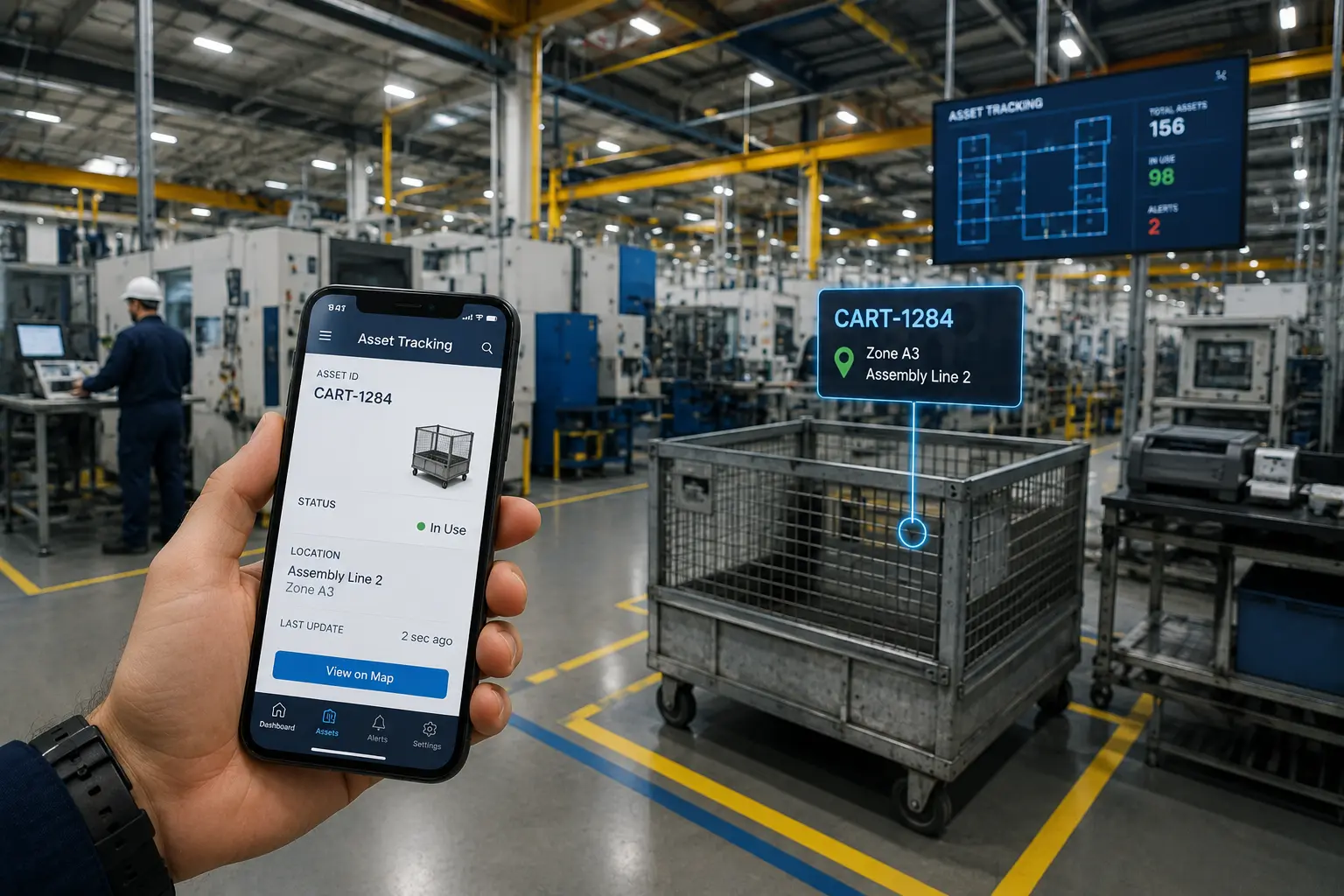
Locate assets & workers across your factory floor
Two location layers on one shared infrastructure: BLE tags for real-time asset and equipment tracking via NAO® Track, and the NAO® Mobile SDK to geolocate workers on their professional smartphones - with fall detection, zone alerts and emergency response in sensitive environments.
Trusted by leading industrial organisations

What is manufacturing RTLS?
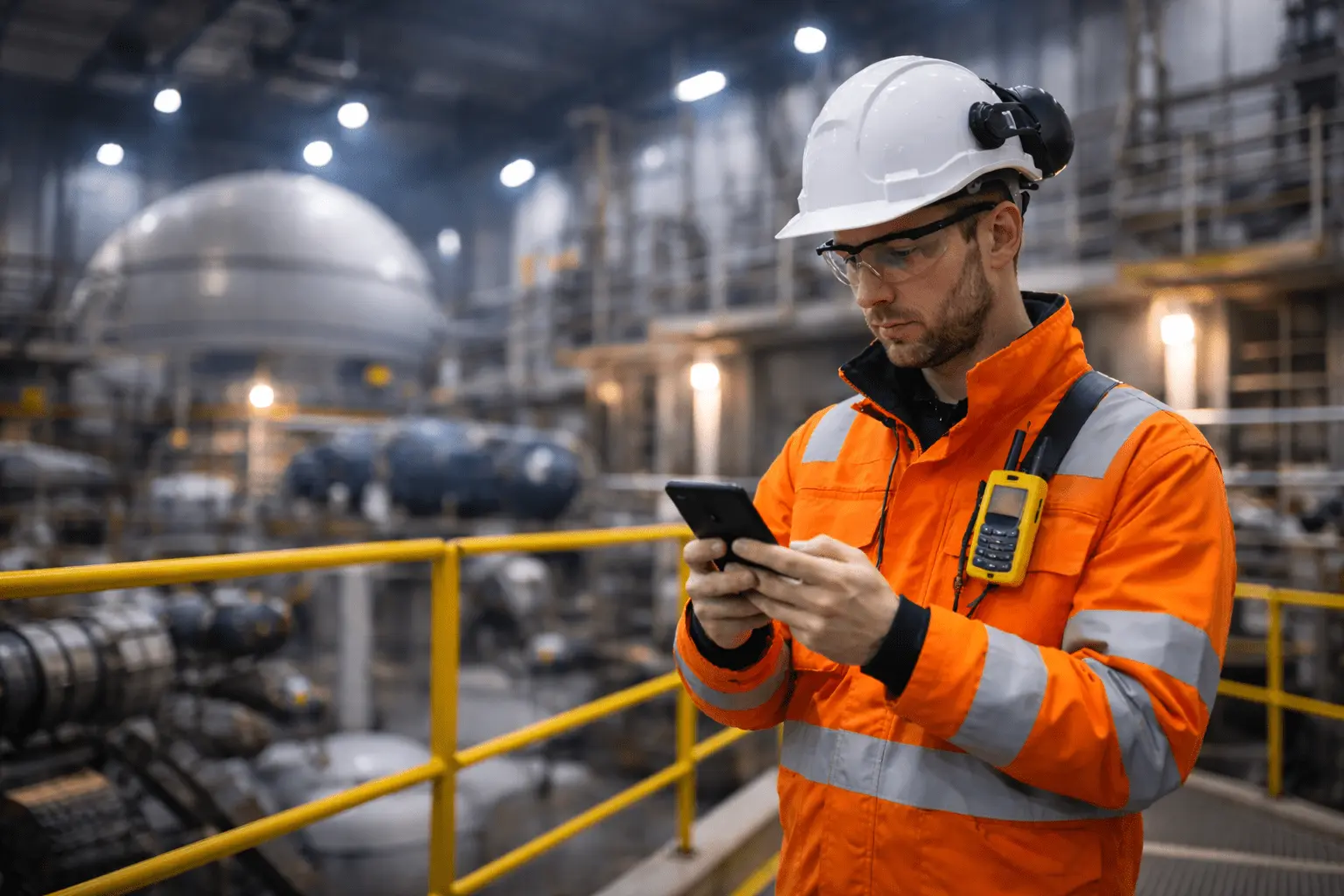
Manufacturing RTLS (Real-Time Location System) is the use of indoor positioning to locate tools, equipment and workers across a factory floor or industrial site. BLE tags on assets are read by existing infrastructure and computed by NAO® Track, while the NAO® Mobile SDK geolocates workers directly on their professional smartphones - enabling fall detection, zone-access monitoring and emergency response in sensitive environments such as industrial plants, nuclear facilities and CO2-protected areas.
Assets tracked, workers protected
Real-time asset tracking via BLE tags on tools and equipment, and worker geolocation via NAO® Mobile on their smartphone - fall detection, zone alerts and emergency management included.
Industrial operators and their teams
Plant managers, operations and maintenance teams, HSE officers, and workers in manufacturing, energy, nuclear and process industries where personnel location is safety-critical.
Safety obligations in sensitive environments
Manufacturers and industrial operators face increasing pressure to protect lone workers, demonstrate regulatory compliance and react instantly in dangerous zones - without adding dedicated hardware to each worker.
Two layers, one shared infrastructure
NAO® Track locates BLE-tagged equipment on the existing BLE/Wi-Fi network. The NAO® Mobile SDK runs on workers' professional smartphones on the same infrastructure - no parallel deployment required.
What slows down the factory floor - and what puts workers at risk
Without real-time location, manufacturers lose time, assets and visibility across the shop floor - and cannot protect workers in safety-critical zones.
Tools and assets are hard to find
Workers spend time searching for tools, equipment and assets across the plant.
Mobile assets move constantly and have no real-time location.
Lost productivity and delays on the line.
Production bottlenecks go unseen
Operations teams lack a real-time view of how the production flow actually runs.
Manual monitoring cannot show where work stalls or slows.
Bottlenecks persist and throughput suffers.
Low asset utilization and losses
Expensive assets are underused, misplaced or lost to theft.
No visibility into where assets are or how often they are used.
Higher costs and reduced competitiveness.
No traceability of task execution
Managers cannot tell how long each production step takes or where time is lost.
Asset and work-order data are not connected to physical location.
Inefficient planning and missed optimization opportunities.
Lone workers in hazardous zones
Workers operating alone in high-risk areas - confined spaces, CO2 zones, nuclear facilities - cannot be monitored effectively.
No real-time location data from the worker's device means a fall or incident can go undetected for minutes.
Delayed emergency response and heightened risk of serious injury - or worse.
No fall detection in the field
A worker who falls in a remote area of the plant cannot automatically trigger an alert.
Traditional safety systems rely on manual triggers or dedicated hardware - not always worn or carried.
Intervention arrives too late; regulatory and liability exposure increases.
Access to sensitive zones is uncontrolled
In nuclear plants, energy facilities and restricted industrial zones, knowing exactly who is present at all times is a safety and compliance requirement.
Badge swipes give entry/exit data but not precise indoor location throughout the zone.
Compliance gaps and inability to evacuate and account for every person in a critical incident.
Emergency coordination without location
When an incident occurs, safety teams have no live view of where workers are across the site.
Worker locations are not tracked in real time, so mustering and evacuation rely on radio calls and manual checks.
Slower, less reliable emergency response and incomplete headcounts.
What Pole Star locates across the plant
Two-layer real-time location
Assets tracked · Workers protected
BLE tags on tools and equipment feed NAO® Track for real-time asset location and production-flow monitoring. Workers carry their professional smartphone - the NAO® Mobile SDK geolocates them continuously, detects falls and triggers zone alerts in sensitive environments.
What Pole Star locates
Two layers, one shared infrastructureTools & equipment
BLE tagLocated in real time so teams stop searching and keep the line moving.
High-value assets
BLE tagTracked to raise utilization and cut theft and losses.
Workers & technicians
NAO® MobileGeolocated via their professional smartphone - no dedicated badge. Covers the full site, including lone workers in remote areas.
Lone workers in hazardous zones
NAO® MobileFall detection and zone-exit alerts keep workers safe in CO2 areas, confined spaces and nuclear or energy facilities - all from the smartphone they already carry.
Field & maintenance staff
NAO® MobileContinuously located across the plant - for rapid emergency response, task tracking and site-access compliance.
Production work-in-progress
BLE tagParts and sub-assemblies tracked through each station to identify bottlenecks and measure cycle time.
Environments covered
Across the plantProduction & shop floor
Active lines where tools, assets and workers move and must be located in real time.
Sensitive & restricted zones
CO2-protected areas, energy facilities, nuclear sites and confined spaces requiring precise worker location and fall detection.
Tool cribs & asset storage
Storage areas where equipment is quickly found and utilization is measured.
Entry, exit & site perimeter
Access points and premises where worker presence and movement are monitored for safety and compliance.
Maintenance & technical areas
Plant rooms and field zones where lone workers must be located and protected at all times.
Logistics & loading docks
Zones where mobile assets and vehicles are tracked to keep operations moving.
How manufacturers use real-time location
Concrete scenarios across asset tracking, production monitoring and worker safety - two layers on one shared infrastructure.
How to locate tools and equipment in real time
A worker needs a specific tool or asset to keep the line moving.
BLE tags report each asset's live location via the existing plant network.
Less time searching, more time producing.
How to monitor production flow and spot bottlenecks
Output slows and the cause is unclear.
Asset location through each station shows exactly where the flow stalls.
Bottlenecks identified and removed faster.
How to improve asset utilization rate
Expensive assets sit idle or go missing during production or drydock.
Location data reveals how often and where each asset is actually used.
Higher utilization and fewer losses.
How to geolocate workers across the plant
A safety manager needs to know where every worker is on site at any moment.
The NAO® Mobile SDK runs on workers' professional smartphones - continuous location with no dedicated badge.
Full site visibility with zero additional hardware per worker.
How to detect a fall and alert safety teams automatically
A worker falls in a remote area of the plant and cannot call for help.
The smartphone's sensors detect the fall and instantly trigger an alert with the worker's precise indoor location.
Faster intervention - no panic button, no manual trigger needed.
How to protect lone workers in sensitive zones
A worker enters a CO2-protected zone, confined space or nuclear facility area where manual supervision is impossible.
Zone-entry alerts are triggered automatically and the worker is continuously located throughout their time in the zone.
Regulatory compliance and real protection for the most exposed workers.
How to coordinate emergency response across a large site
An incident requires immediate evacuation or intervention across multiple zones.
Safety teams see every worker's live position on a site map - headcount, mustering status and intervention routing in real time.
Faster, more reliable emergency response and verified headcounts.
What real-time location delivers
Three outcomes manufacturers gain from locating assets, monitoring flow and protecting workers on the shop floor and in sensitive environments. The benefits below are qualitative.
Savings
- Increase the asset utilization ratio
- Reduce theft and missing equipment
- Increase competitiveness
Efficiency
- Shift employee time and reduce labor
- Monitor production flow in real time and remove bottlenecks
- Understand the time spent on each task
Safety
- Geolocate workers on their smartphone via NAO® Mobile - no dedicated badge
- Detect falls automatically and alert safety teams with the worker's precise location
- Protect lone workers in sensitive zones: CO2 areas, confined spaces, nuclear and energy facilities
- Implement an emergency management process with live headcount and mustering
- Monitor site entrance and exit for compliance and safety
Pole Star solutions for manufacturing
The capabilities most relevant to plant and operations teams - all powered by NAO® Track on existing infrastructure.
Asset tracking
Locate tools, equipment and high-value assets in real time to raise utilization and cut losses.
Explore asset trackingFlow analytics
Monitor production flow, identify bottlenecks and understand the time spent on each task.
Explore flow analyticsWorker safety
Protect workers, support emergency management and monitor movement, entry and exit on site.
Explore worker safetyManufacturing location, answered
How does asset tracking work on the factory floor?
Assets are equipped with BLE tags whose signals are read by the plant's existing BLE or Wi-Fi infrastructure. NAO® Track computes their real-time location and feeds dashboards and alerts without any dedicated positioning hardware.
Can it help identify production bottlenecks?
Yes. By monitoring tagged assets and work-in-progress through each station in real time, Pole Star reveals exactly where the flow stalls - so operations teams can remove bottlenecks and improve throughput.
What types of assets can be tracked?
Tools, jigs, trolleys, containers, sub-assemblies, vehicles and any mobile equipment. BLE tags are compact and battery-powered, so they can be attached to virtually any asset on the shop floor.
Does it require new infrastructure?
No. NAO® Track is designed to run on the BLE-capable network already deployed in the plant - Cisco, HPE Aruba or similar - so manufacturers can deploy asset tracking without a parallel infrastructure project.
How does Pole Star locate workers in a factory?
The NAO® Mobile SDK runs directly on workers' professional smartphones, using the same BLE and Wi-Fi infrastructure as NAO® Track. No dedicated badge or wearable is needed - the smartphone in their pocket is the location device.
Does it include fall detection?
Yes. The NAO® Mobile SDK uses the smartphone's accelerometer and sensors to detect a fall and automatically trigger an alert, giving safety teams the worker's precise indoor location without any manual action from the worker.
Can it be used in sensitive environments like nuclear plants?
Yes. NAO® Mobile is particularly well suited to industrial sites, energy facilities and nuclear plants where knowing exactly who is present in a zone at any moment is a safety and regulatory requirement. Zone-entry and zone-exit alerts are configured per area.
What about lone worker protection in hazardous zones?
Lone workers in CO2-protected areas, confined spaces or high-risk technical zones are continuously located. A fall or an unresponsive worker triggers an automatic alert to safety teams, with the worker's last known position - no dedicated panic button required.
Does worker location and asset tracking share the same infrastructure?
Yes. Both layers run on the same existing BLE / Wi-Fi network. NAO® Track handles the assets via BLE tags; the NAO® Mobile SDK handles workers via their smartphones. One infrastructure, two location layers, no duplication.
Bring real-time visibility to your factory floor
Locate every tool, asset and worker in real time, identify production bottlenecks and improve worker safety with NAO® Track and NAO® Mobile - all on your existing BLE and Wi-Fi infrastructure. Book a demo to see it on your factory floor.