
Trigger the right action
the moment a boundary is crossed.
For hospitals, aged-care facilities, industrial plants and cruise ships that need automatic alerts when people or assets enter, exit or dwell in any defined zone - without GPS, without manual monitoring.
What is indoor geofencing?
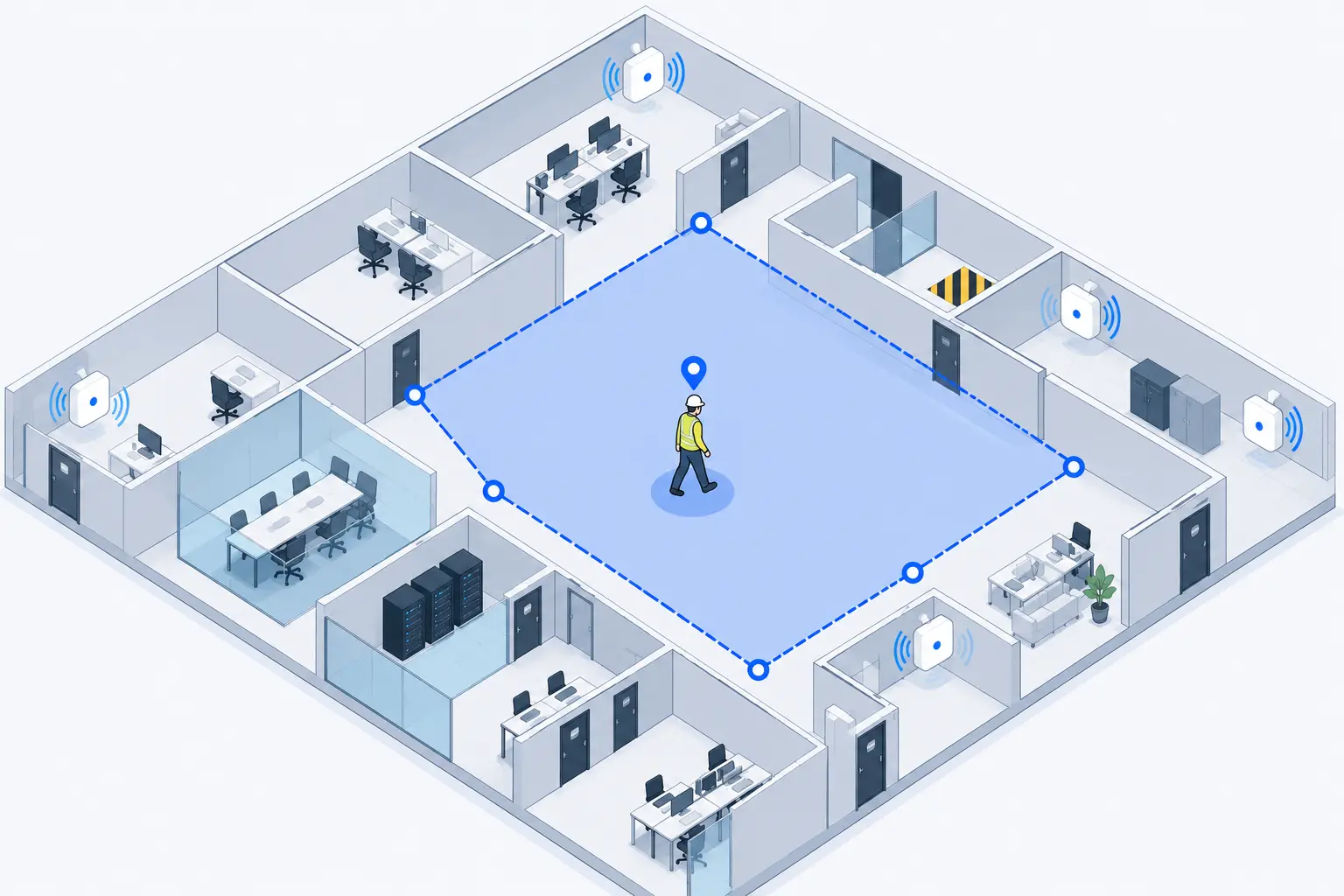
Indoor geofencing is the real-time monitoring of people and assets relative to defined virtual zones inside a building. When a tracked person or object enters, exits or dwells within a configured perimeter, the system automatically triggers an alert, a log entry or an automated workflow - without GPS, without manual observation and without delay.
Virtual perimeters on a building floor plan. Automatic event when a badge, smartphone or asset tag crosses - in real time, at room or zone level.
Healthcare, aged care, maritime, industrial and smart building operators managing staff safety, asset containment, restricted area compliance or evacuation verification.
Manual zone monitoring fails at night, during emergencies and at scale. Regulatory pressure on staff safety, patient wandering and CO₂ zone verification is forcing the shift to automatic detection.
NAO® Track runs on BLE infrastructure already in your building. Zones drawn in NAO® Maps. Every crossing fires an alert, a log entry or an API event - in seconds.
Manual zone monitoring fails precisely when it matters most.
Every regulated facility has zones that require access control: restricted clinical areas, hazardous machinery spaces, CO₂-protected engine rooms, wandering-risk wards. The common approach - checking manually, relying on badge-swipe readers or reviewing CCTV retrospectively - produces logs, not real-time awareness. By the time someone reviews the footage, the incident has already happened.
The structural problem is scale. A single floor in a large hospital can contain dozens of distinct zones - medication rooms, sterile areas, isolation wards, equipment stores - each with different access rules. Monitoring them simultaneously, continuously and accurately is beyond what manual processes or static badge systems can deliver. The consequence is exposure: regulatory, operational and safety.
of hospitals report asset loss
Nearly three quarters of healthcare facilities report regular unexplained equipment loss from authorized zones.
ECRI Institute, Healthcare Asset Management Surveyof dementia residents wander
Up to 40% of aged-care patients with dementia will attempt to leave designated safe areas during a stay.
Alzheimer's Association, 2023average detection delay
Without automated zone monitoring, the average time between a zone breach and staff awareness exceeds 6 minutes.
RTLS Industry Benchmark Report, 2024cost per unauthorized CO₂ activation
Injury liability, regulatory fines and operational shutdown combined after a CO₂ flooding event in an occupied space.
Maritime Safety Commission estimatesWhat geofencing delivers for operations teams
Instant breach detection
Zone crossings are detected and alerted in seconds - not minutes. Staff respond before a situation escalates rather than reviewing it retrospectively.
Automatic compliance logging
Every zone entry, exit and dwell event is timestamped and stored automatically - producing the audit trail that regulators and insurers require without manual documentation.
Contained assets and people
High-value equipment stays within authorized zones. Residents at wandering risk are detected at zone boundaries before they reach unsafe areas.
Precise indoor coverage
Room-level and zone-level accuracy inside buildings where GPS provides no signal - across multiple floors, underground areas and metal-clad industrial environments.
Reduced monitoring workload
Supervision teams stop manually watching zones and start responding to alerts. The system monitors every zone simultaneously, 24 hours a day, without fatigue.
Works on existing infrastructure
Geofences are drawn on top of BLE infrastructure already installed in the building - Cisco, Aruba or Fortinet. No new network required, no additional cabling.
Sound familiar?
These are the zone monitoring problems that operations, safety and compliance teams bring to us - formulated the way they talk about them internally, not the way vendors market at them.
"We have no idea when someone enters a restricted area until a colleague tells us."
Restricted zone compliance depends entirely on human observation - which fails at night, during shift handovers and in areas with low staff density.
Zero real-time visibility"A resident wandered onto the wrong floor last week. We only knew because a nurse spotted them."
Wandering incidents in aged care and hospital environments cause patient harm and carry serious regulatory and liability consequences.
Up to 40% of dementia residents wander"We can't prove to auditors that our CO₂ zones were clear before activation."
CO₂ fire suppression systems require documented proof of evacuation completion before activation. Manual logs are disputed and retrospective - they do not satisfy modern audit standards.
SOLAS / IMO compliance risk"Expensive equipment disappears from the department and we find it in the wrong wing days later."
Assets that leave authorized zones without triggering an alert become effectively invisible until a manual search locates them - costing hours of staff time per incident.
Average 6+ hrs per search"We have no automatic alert when a technician enters a hazardous machinery area alone."
Lone worker safety in confined spaces and hazardous zones requires zone-entry awareness. Without it, supervisors cannot trigger the monitoring or escalation the regulations require.
Regulatory lone worker obligation"Our badge system logs entries but gives us no real-time alert - just a report the next morning."
Static access control generates access logs, not real-time presence awareness. The difference is the gap between prevention and retrospective investigation.
Detection delay: hours to daysFrom BLE signal to zone alert - in seconds.
BLE infrastructure captures signals
Access points from Cisco, Aruba or Fortinet already deployed in the building continuously capture BLE signals from badges, tags or smartphones carried by staff, residents or assets.
Existing infrastructure - no new cablingNAO® Positioning Engine computes location
The NAO® Positioning Engine processes incoming signals and calculates the real-time indoor position of every tracked entity - to room level or zone level, updated continuously.
Room-level accuracy - multi-floorGeofences defined on NAO® Maps
Operations managers draw zone perimeters directly on the building floor plan in NAO® Maps - configuring entry rules, exit rules, dwell time thresholds and escalation paths for each zone.
No-code zone configurationZone crossing fires an event
The moment a position update places a tracked entity inside or outside a configured perimeter, NAO® Track fires the configured response - an alert to a supervisor dashboard, an API call to a third-party system or an automated workflow.
Alert - API event - Workflow triggerLogged, auditable, exportable
Every zone event is timestamped, stored and exportable - providing the compliance documentation that regulators, insurers and safety auditors require, automatically, without manual logs.
Automatic audit trailA patient with dementia begins moving toward the stairwell exit on floor 3. Their BLE wristband - the same one used for nurse call - crosses the geofence boundary configured around the safe ward perimeter.
NAO® Track fires an alert within seconds. The duty nurse's dashboard shows the patient's name, current position on the floor plan and the time of the crossing. A second nurse in the corridor confirms the alert and intercepts the patient before they reach the exit.
The event is automatically logged - timestamp, patient ID (anonymized), zone crossed, alert time, acknowledgement time - and added to the incident record without any manual documentation step.
The same system, the same infrastructure and the same software handles the medication room door on floor 2, the equipment store on floor 1 and the CO₂ engine room on the ship berthed at the dock. One platform, every perimeter.
Answers to what buyers actually ask
These are the capabilities that come up in every geofencing evaluation - answered by what NAO® Track delivers in production deployments today.
Multi-zone, multi-floor configuration
Draw any number of geofences on any floor plan - from a single room to a full building across multiple levels. Each zone has its own rules, alert recipients and dwell time thresholds.
Supports overlapping zones and zone hierarchies
Real-time entry, exit and dwell alerts
Trigger on zone entry, zone exit or time spent inside a zone without movement - covering the three scenarios that matter operationally: access, departure and immobility.
Alert latency in real time from crossing event
Automatic timestamped audit log
Every zone event is stored with a precise timestamp, entity identifier and zone reference - generating a verifiable compliance record without manual documentation.
Exportable for SOLAS, ISO, GDPR and internal audits
REST API and MQTT event streaming
Every zone crossing publishes an event to the NAO® API - integrating directly with CMMS, EHR, nurse call, BMS or security platforms without requiring a separate dashboard.
Connects to Cisco Spaces, HPE Aruba, and custom systems
Works on your existing Cisco, Aruba or Fortinet network
Geofencing runs on the BLE-capable access points already installed in your building. No additional hardware is required - only zone configuration and, where needed, BLE tags or wristbands.
No new infrastructure, no additional cabling
On-premise or cloud deployment
Deploy NAO® Track on-premise for environments with strict data sovereignty requirements - maritime vessels, secure industrial sites, regulated healthcare facilities - or in NAO® Cloud for faster rollout.
No internet dependency in on-premise mode
Geofencing in practice — six scenarios that go live within weeks
Detect unauthorized access to medication rooms
Alert staff when a wandering-risk resident approaches an exit
Verify all crew have evacuated before CO₂ suppression activates
Alert when high-value equipment leaves its authorized zone
Monitor confined space entry and trigger lone worker protection automatically
Track real-time occupancy against fire-safety capacity limits
From BLE signal to zone alert - the full pipeline
Six layers connect a physical crossing event to the alert, the log entry and the API call - all in seconds, on infrastructure you already own.
BLE infrastructure
Cisco, Aruba or Fortinet access points already installed in the building continuously capture BLE signals from wristbands, badge tags or smartphones. No new hardware required.
NAO® Positioning Engine
Signal data is processed in real time by the NAO® Positioning Engine, which computes the continuous indoor position of every tracked entity - updated every few seconds, at room or zone level.
NAO® Maps - geofence layer
Virtual zone perimeters are drawn on the building floor plan in NAO® Maps. Each zone has configurable rules: entry alert, exit alert, dwell time threshold, alert recipient list.
Zone crossing detection
The moment a position update places a tracked entity inside or outside a configured perimeter, NAO® Track triggers the configured event - within seconds of the physical crossing.
Alert + API event dispatch
Alert sent to supervisor dashboard. API event published via REST or MQTT for integration with nurse call, CMMS, BMS or security systems. Automated workflow triggered if configured.
Audit log generated automatically
Every zone event is timestamped, stored and exportable - producing the compliance documentation required for SOLAS, ISO, GDPR and internal safety audits without any manual input.
Where indoor geofencing is most often deployed
Hospitals & Clinical Facilities
Hospitals manage dozens of zone types simultaneously — medication rooms, sterile areas, isolation wards, equipment stores, pediatric wings. Geofencing provides real-time access visibility and automatic audit logging across every restricted area, replacing manual observation with automatic detection. Wandering patient alerts and asset zone-exit notifications reduce incident response times and support JCI and CQC compliance.
Healthcare RTLSCruise Ships & Maritime Fleet
CO₂-protected engine rooms and machinery spaces require verified evacuation before suppression activation. Geofencing provides automatic zone-occupancy monitoring and confirmed-clear status in real time — replacing manual roll calls with automatic detection on the vessel's existing Cisco BLE infrastructure. Carnival Maritime deployed this across 11 ships.
Maritime & cruiseManufacturing & Industrial Plants
Hazardous zones, confined spaces, high-voltage areas and permit-to-work locations require continuous occupancy awareness. Geofencing enables automatic lone worker monitoring activation on zone entry, real-time alert dispatch and permit-compliance logging — without adding hardware beyond the existing BLE infrastructure.
Manufacturing RTLSAlso deployed in
Geofencing in production — two deployments, two very different environments
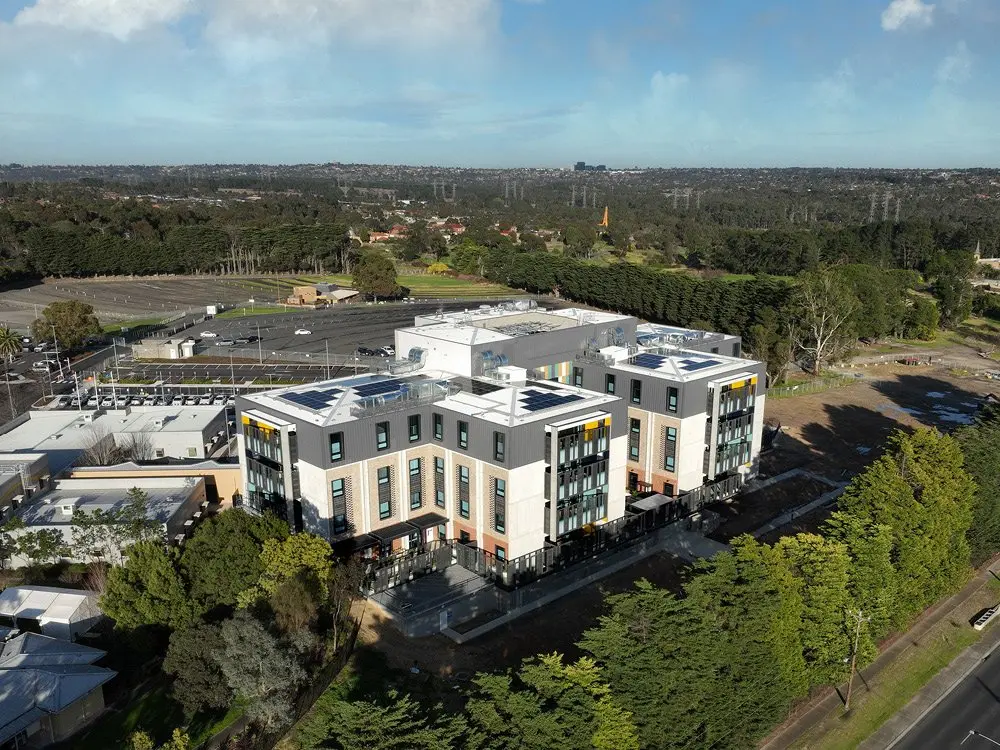

Monitor wandering-risk residents and staff zones across a four-floor aged-care facility without a dedicated network or additional fixed infrastructure.
BLE geofencing on Cisco Spaces — zone perimeters configured on NAO® Maps, resident wristbands and staff badges tracked in real time across all floors.
- Zone breach alerts across a 14,000 m² four-floor facility
- Resident wandering detected before exit - not after
- Automatic compliance log for every zone event - no manual documentation


Replace manual CO₂ mustering roll-calls in engine rooms and machinery spaces across an entire fleet - with automatic zone-clear confirmation that works with no internet dependency.
CO₂ zone geofences configured on existing Cisco BLE infrastructure across 11 ships - automatic occupancy monitoring and zone-clear confirmation via NAO® Track.
- Digital CO₂ mustering across 11 ships and 38 engine rooms and protected zones
- Zone-confirmed-clear status in real time - no radio call required
- Full SOLAS audit trail generated automatically - 100% on-premise
How Pole Star geofencing compares
| Criterion | Pole Star NAO® Track | Traditional access control | Manual monitoring |
|---|---|---|---|
| Alert latency | In real time | Log-only, no real-time alert | Minutes to hours |
| Zone coverage | Unlimited zones, any shape | Fixed door/reader points only | Observer-dependent |
| Multi-floor support | Native, single interface | Floor-by-floor reader networks | Requires staff on each floor |
| Dwell time alerts | Configurable per zone | Not supported | Not supported |
| Audit trail | Automatic, timestamped | Entry log only, no context | Manual — error-prone |
| API integration | REST + MQTT, open | Proprietary, limited | None |
| Infra dependency | Existing BLE network | Dedicated reader hardware | Human staff |
| GPS-denied environments | Full indoor coverage | Reader-point only | Full coverage (manual) |
Your infrastructure is already there
Pole Star geofencing runs on Cisco, Aruba or Fortinet access points already deployed in your building. Zone configuration is software-only — no new hardware, no additional cabling, no parallel network.
One platform — every zone scenario
The same NAO® Track deployment handles restricted area access, wandering residents, CO₂ evacuation, asset containment and lone worker entry — not separate systems for each use case.
Compliance built in, not bolted on
Every zone event generates an automatic, timestamped, exportable audit log — satisfying SOLAS, ISO, GDPR and internal safety audit requirements without any manual documentation step.
20 questions buyers ask before deploying indoor geofencing
Technical operation
What is indoor geofencing?
Indoor geofencing is the real-time monitoring of people and assets relative to virtual zones defined inside a building. When a tracked person or object enters, exits or dwells within a configured perimeter, the system automatically triggers an alert, a log entry or an automated workflow - without GPS, without manual observation and without delay.
How is indoor geofencing different from GPS geofencing?
GPS geofencing works outdoors using satellite coordinates. Indoor geofencing uses BLE or Wi-Fi signals from access points inside the building to compute position - making it functional in hospitals, ships, underground facilities and any environment where GPS signals are unavailable or inaccurate.
How accurate is indoor geofencing with BLE?
With BLE infrastructure from Cisco, Aruba or Fortinet, NAO® Track achieves room-level accuracy - typically 3 to 5 metres in well-covered environments. This reliably detects zone entry and exit events with alert latency in real time.
Can geofences be configured on multiple floors?
Yes. NAO® Maps supports multi-floor floor plans with independent zone configurations on each level. A single zone crossing event includes the floor identifier, enabling precise routing for response teams.
What types of events can a geofence trigger?
NAO® Track triggers on zone entry, zone exit and dwell time threshold - the time a tracked entity has been present in a zone. Each type can have a different recipient, escalation path and API payload.
Can geofences overlap?
Yes. Overlapping zones are fully supported. A position can simultaneously satisfy multiple zone conditions - a room inside both a department perimeter and a restricted area perimeter - with each geofence firing its own independent event.
Deployment and infrastructure
Does indoor geofencing require new hardware?
No new fixed hardware if the building already has BLE-capable access points from Cisco, Aruba or Fortinet. Zones are drawn in software. Tracked entities carry a BLE wristband, badge tag or their existing smartphone with NAO® Mobile SDK integrated.
Can our existing Cisco or Aruba network be used?
Yes. NAO® Track integrates natively with Cisco Spaces, HPE Aruba and Fortinet. BLE positioning data flows from access points to the NAO® Positioning Engine via the existing network - no parallel infrastructure required.
How many zones can the system manage simultaneously?
No hard limit. Carnival Maritime manages 38 CO₂ zones across 11 ships from a single deployment. Enterprise deployments covering hundreds of zones across multiple buildings run on the same platform.
Can zones be modified after deployment?
Yes. Zone boundaries, alert rules, dwell thresholds and recipient lists are configurable in NAO® Maps without technical intervention. Changes take effect immediately.
ROI and business case
How does geofencing reduce compliance costs?
Every zone event is automatically timestamped, logged and exportable. This eliminates manual documentation for safety audits, SOLAS inspections, JCI reviews and GDPR data access logs - and produces a verifiable record that manual logs cannot provide.
Can geofencing replace manual zone monitoring?
Yes, for detection and logging. NAO® Track monitors every configured zone simultaneously and continuously, without fatigue or shift dependency. Human oversight remains appropriate for response - but detection shifts from observation to automatic real-time monitoring.
Security, compliance and data
Is location data stored locally or in the cloud?
Both modes are supported. On-premise deployment on NAO® Server stores all data locally with no external connectivity - preferred for maritime vessels, industrial facilities and regulated healthcare. NAO® Cloud is available where data residency permits.
How does the system handle GDPR compliance?
NAO® Track supports GDPR through role-based access control, data retention policies, pseudonymization of tracked identifiers and audit log export for data subject access requests. Location data is processed only for the configured purpose.
Can geofence logs be used in audits?
Yes. Zone event logs are timestamped with millisecond precision, include entity identifier, zone name and event type, and are exportable in standard formats. Used to support SOLAS documentation, ISO audits and internal incident investigations.
Does the system function if the Wi-Fi goes down?
BLE position updates depend on the access point network. In on-premise deployments, the NAO® Server continues on the local network if internet is lost. For maritime and industrial environments, Pole Star designs deployments with redundancy appropriate to the operational context.
See geofencing running
in your facility.
Every zone, every crossing, every alert - automatically. Book a walkthrough and we will show you how NAO® Track handles your specific environment on the infrastructure you already own.
Ready to evaluate
See geofencing in action on a live demo environment
Still researching
Read how Wantirna and Carnival Maritime deployed it