

Airport baggage cart tracking has become a central component of modern airport asset tracking systems. In large, multi-terminal environments, ensuring the continuous availability of baggage carts while maintaining operational efficiency is a structural challenge.
Airports operate within complex ecosystems involving passenger flows, ground handling teams and airside coordination. Without real-time asset tracking, baggage cart management often relies on manual verification, reactive redistribution and fragmented information.
In such environments, the absence of structured visibility generates inefficiencies that scale rapidly.
The operational risk of not implementing airport baggage cart tracking
Without an airport baggage cart tracking system, operational teams frequently mobilize staff to conduct physical rounds across terminals. Supervisors verify cart availability zone by zone, manually assessing whether sufficient units are present at check-in counters, arrival halls or intermodal areas.
This process creates several operational constraints.
First, it diverts human resources from higher-value operational tasks. Ground teams spend time searching for carts instead of focusing on passenger service or coordination activities.
Second, manual inventory checks are inherently reactive. By the time a shortage is detected, passenger experience may already be impacted.
Third, decision-making remains assumption-based. Without real-time data, it becomes difficult to determine whether shortages stem from insufficient fleet size, poor distribution or temporary passenger flow fluctuations.
In high-density airport environments, these inefficiencies affect airport operational efficiency, ground support equipment coordination, stakeholder collaboration and asset governance.
Airport baggage cart tracking eliminates these blind spots by embedding real-time asset visibility into daily operations.
How real-time asset tracking improves airport ground operations
A modern airport indoor positioning system provides continuous visibility over mobile assets across landside and airside zones.
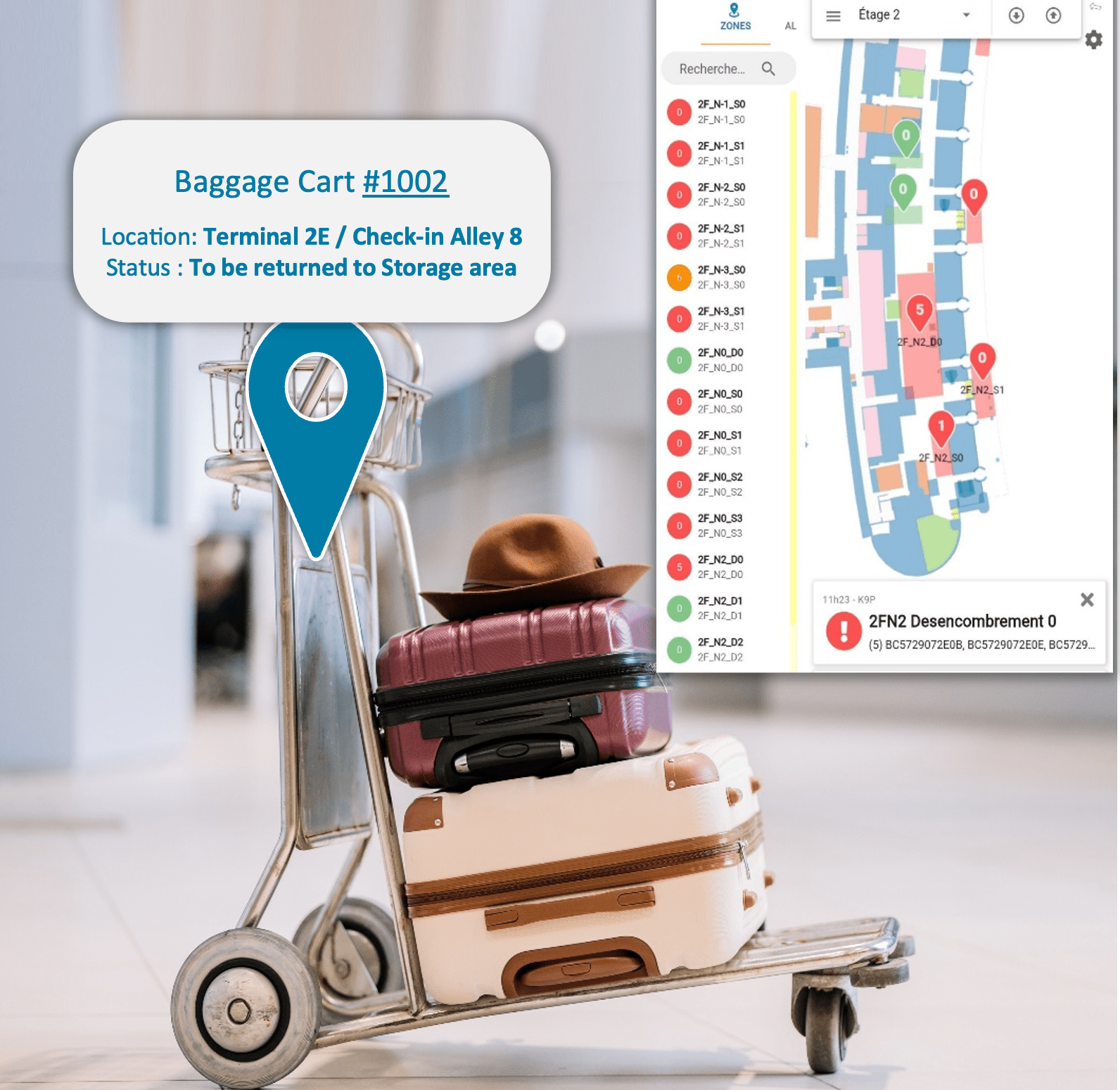
By enabling real-time asset tracking in airports, operators can monitor baggage cart distribution dynamically across predefined operational zones. Instead of relying on sporadic physical inspections, they access centralized dashboards reflecting live asset positioning.
Zone-based asset tracking allows airports to digitally define key operational areas such as check-in counters, security exits, boarding gates and storage zones. Automated asset counting within each zone ensures that cart availability is continuously monitored.
When imbalances occur between high-traffic passenger zones and lower-demand areas, redistribution can be initiated proactively.
This transition from manual oversight to structured monitoring enhances operational stability and reduces friction in airport ground operations.
From manual rounds to continuous asset visibility
In traditional baggage cart management models, human presence is required to validate asset availability. Staff may conduct repeated inspections during peak periods to ensure carts are present in critical zones.
This approach introduces variability and delays. It also limits historical insight. Without structured data, it is difficult to analyze long-term movement patterns or identify recurring inefficiencies.
Airport baggage cart tracking introduces continuous fleet monitoring, historical movement analysis, detection of abnormal displacement and structured asset governance.
Real-time asset tracking transforms baggage cart management from a logistical burden into a measurable, data-driven operational function.
How Pole Star is transforming baggage cart management
Thanks to a strong partnership strategy, the solution uniquely leverages existing WLAN infrastructures such as Cisco, HPE Aruba, Fortinet and other major vendors.
This enables airports to deploy NAO® Track without installing additional dedicated hardware. This approach simplifies deployment, reduces technical complexity, and preserves architectural consistency within the airport’s IT environment.
Enhancing asset governance and strategic planning
Beyond immediate operational benefits, airport baggage cart tracking strengthens long-term asset governance.
With historical analytics and movement data, airport managers can evaluate utilization trends, identify persistent imbalances and refine redistribution strategies.
Real-time asset tracking supports evidence-based planning, reduced unnecessary staff mobilization, improved coordination between airport operators and ground handlers and greater transparency in asset allocation.
In critical infrastructure environments, continuous visibility enhances resilience. Structured data replaces assumption-driven decisions.
Airport baggage cart tracking becomes an integral component of a scalable airport asset tracking system aligned with smart airport transformation initiatives.
From reactive logistics to digitalized asset optimization
Implementing airport baggage cart tracking represents a strategic evolution.
Without real-time asset tracking, cart management remains dependent on human verification and reactive coordination. With a structured airport indoor positioning system, asset visibility becomes continuous, automated and measurable.
This transformation improves operational efficiency, strengthens governance and enhances passenger experience.
In an environment where precision and coordination define performance, airport baggage cart tracking is not merely a technological enhancement, it is an operational standard for modern smart airports.
Case study: airport baggage cart tracking at Paris Charles de Gaulle Airport
A large-scale deployment of airport baggage cart tracking has been successfully implemented at Paris Charles de Gaulle Airport (CDG) in collaboration with Atalian, Hub One, and Cisco.
The project enables the real-time monitoring and counting of thousands of baggage carts across airport terminals using Pole Star’s indoor location platform. By providing continuous visibility on cart distribution, operational teams can ensure that the right number of carts is available in the right place at the right time while reducing manual checks and improving operational efficiency.
👉 Read the full case study:
Airport baggage cart tracking at Paris Charles de Gaulle Airport