
Introduction
In maritime operations, safety procedures are built around one critical principle: knowing where people are at all times, especially in high-risk environments.
According to the International Maritime Organization, engine room fires remain among the most frequent and dangerous onboard incidents. Data from Allianz Global Corporate & Specialty also shows that machinery damage and engine room-related issues account for a significant share of major marine claims.
In enclosed or CO₂-protected spaces, response time is measured in seconds. The ability to confirm, with certainty, that no crew member remains inside is not just procedural – it is critical to preventing loss of life.
Yet many vessels still rely on manual mustering processes, including headcounts, radio confirmations or written logs. These methods introduce uncertainty at the exact moment when certainty is required. Digital mustering maritime solutions address this gap by transforming crew presence into real-time, actionable data that improves maritime safety, emergency mustering and onboard emergency response.
Why evacuation verification is critical at sea
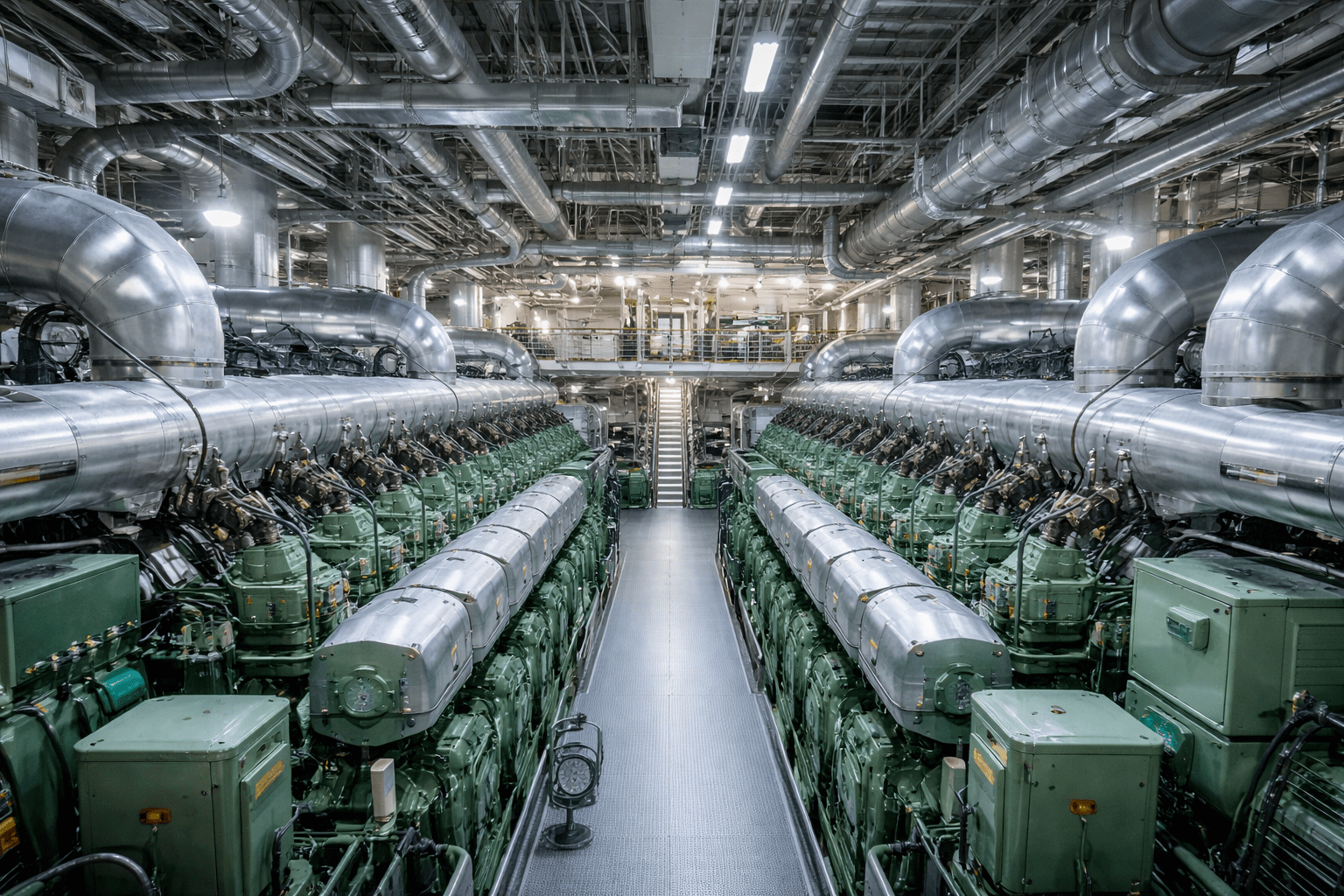
Certain onboard environments require immediate and irreversible actions. Engine rooms, technical compartments and enclosed machinery spaces concentrate both operational risk and human exposure.
According to European Maritime Safety Agency, engine room incidents are consistently among the leading causes of onboard emergencies. These environments are characterized by confined layouts, high temperatures and complex machinery, making evacuation inherently challenging.
In such conditions, safety depends on one key factor: ensuring that no one remains inside before taking action. The challenge is not only to evacuate, but to prove that evacuation has been completed. In these environments, fast crew evacuation and reliable crew presence verification are essential to engine room safety.
The limits of manual mustering procedures
Traditional mustering relies on human coordination under pressure. Crew members report their status, supervisors consolidate information, and decisions are made based on partial visibility.
In reality, emergency conditions degrade the reliability of this process. Communication may be disrupted, visibility reduced by smoke, and noise levels can interfere with coordination. Stress significantly increases the probability of error.
The International Labour Organization highlights that human factors contribute to a majority of operational incidents across industries. In maritime environments, where conditions are more extreme, this dependency becomes even more critical.
Even a single missed confirmation can have irreversible consequences. The issue is not procedure – it is the limitation of relying solely on human input in situations that require real-time crew tracking and emergency headcount accuracy.
What is digital mustering in maritime environments?
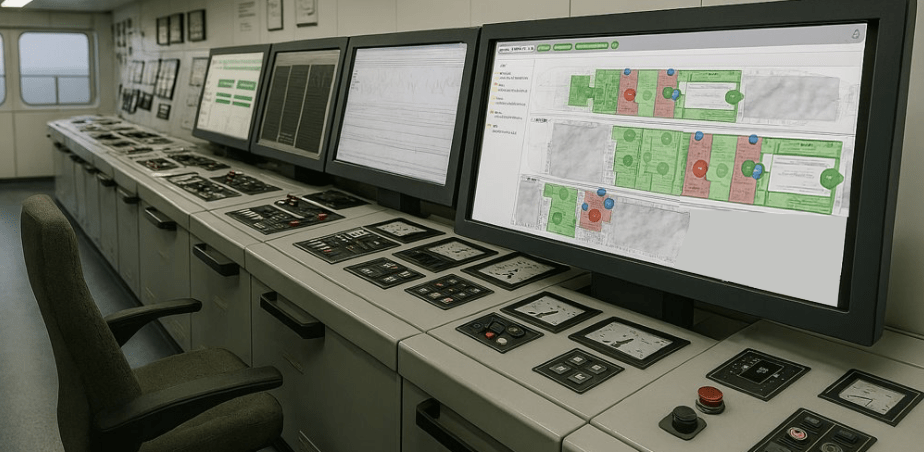
Digital mustering maritime refers to the use of real-time location technologies to automatically track, count and verify the presence of crew members onboard. It acts as a vessel safety system designed to automate crew accountability in critical maritime environments.
Crew members are equipped with wearable devices, such as BLE badges, which continuously communicate with onboard infrastructure. A location engine processes this data to determine personnel positions in real time. This enables continuous crew presence verification across technical zones, cabins, decks and restricted spaces.
This allows operators to instantly understand:
- who is inside a specific zone
- whether a protected area has been fully evacuated
- how personnel are distributed during an incident
Instead of relying on delayed or uncertain reporting, decision-makers gain immediate and objective visibility.
In high-risk environments, this shift from estimation to data is fundamental.
From procedural compliance to measurable verification
Maritime safety is undergoing a structural shift. Compliance is no longer limited to following procedures – it increasingly requires demonstrable evidence.
Operators must now be able to answer critical questions with certainty:
- Was evacuation completed?
- Who was present in the area?
- When was the zone cleared?
Digital mustering maritime enables this level of traceability by generating time-stamped, auditable records of personnel presence and movement.
Crew evacuation becomes a verifiable event, not an assumption, strengthening ship safety compliance and operational accountability.
This distinction is essential in the context of incident investigation, liability exposure and operational accountability.
Key benefits of digital mustering for maritime operators
The impact of digital mustering extends beyond safety procedures.
First, it reduces human risk by ensuring that no crew member is overlooked in critical environments. In scenarios where oxygen levels can become lethal within seconds, even minimal uncertainty is unacceptable.
Second, it accelerates decision-making. Real-time visibility eliminates delays associated with manual verification, allowing faster and more confident actions.
Third, it strengthens compliance by providing objective, auditable records. This is increasingly important as regulatory scrutiny and insurance requirements evolve.
Finally, it supports operational consistency across fleets, enabling standardized safety practices regardless of vessel complexity.
Why on-premise architecture matters for safety systems
In maritime environments, system reliability cannot depend on external connectivity.
A digital mustering maritime solution deployed in a fully on-premise architecture ensures continuous operation, ultra-low latency and independence from satellite networks. This guarantees that safety-critical decisions can be made without delay or uncertainty.
In emergency scenarios, even seconds matter. Systems must therefore be designed for autonomy and resilience.
From monitoring spaces to verifying people
Traditional tools such as CCTV systems provide visibility of spaces, but they do not confirm human presence with certainty.
Digital mustering introduces a critical shift: from monitoring environments to verifying individuals. In high-risk technical areas, this distinction changes the nature of decision-making.
Operators no longer rely on visual interpretation, but on precise, real-time data about personnel presence. Safety moves from observation to verification through digital crew accountability and real-time personnel data.
A new standard for maritime safety
As maritime operations evolve, expectations around safety and accountability continue to increase. Digital mustering maritime is not simply an incremental improvement – it represents a fundamental change in how safety is managed onboard.
By combining real-time visibility, automated verification and auditable data, these systems allow operators to move beyond procedural compliance toward a data-driven approach.
In environments where decisions must be made instantly and without uncertainty, this evolution is becoming the new standard.
To understand how digital mustering ensures 100% crew evacuation before CO₂ release in engine rooms, read our dedicated article