
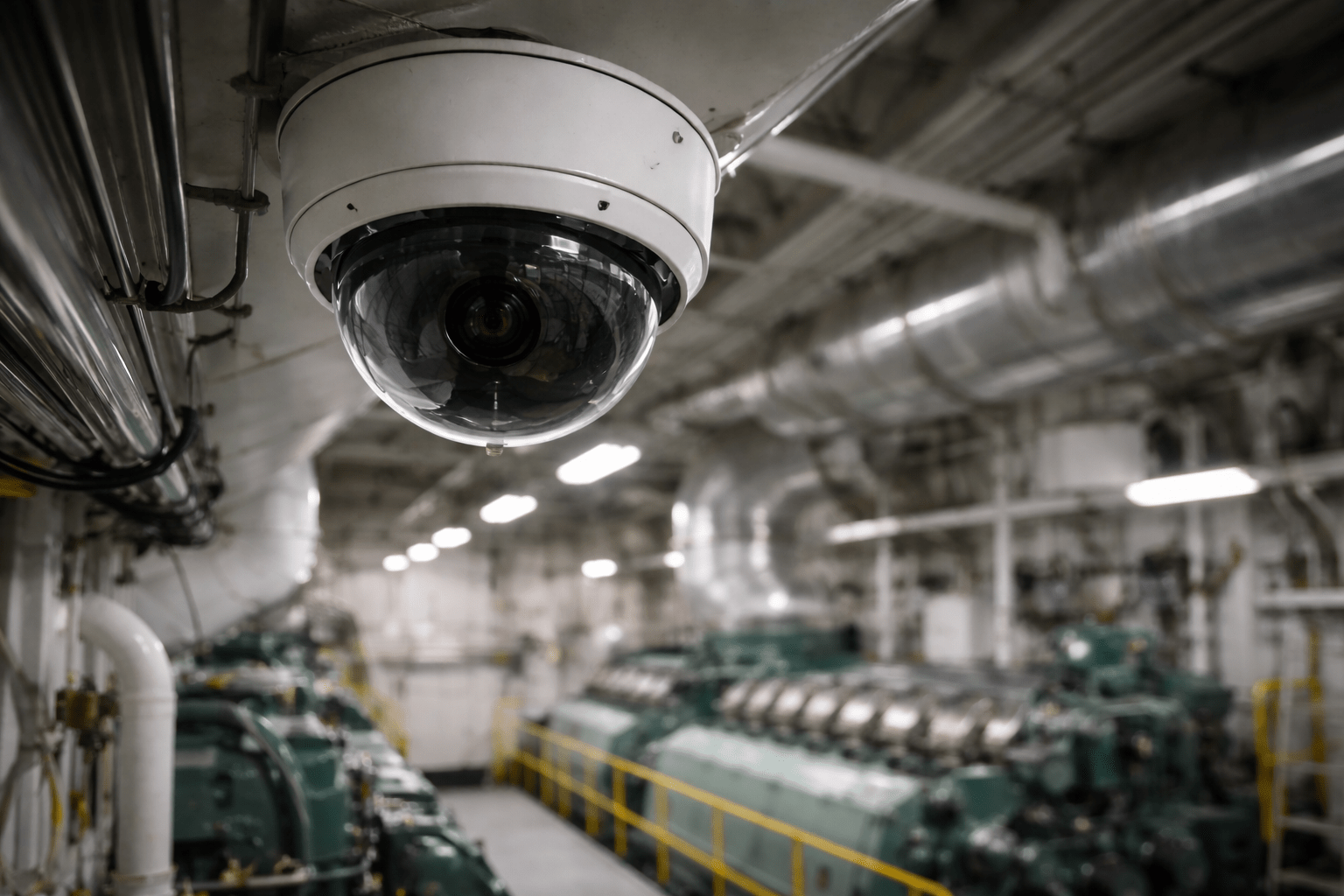
Engine room fires remain one of the most serious safety risks on cruise ships and large commercial vessels. Machinery spaces contain fuel systems, lubricants, electrical equipment, and high-temperature machinery, creating an environment where a fire can escalate rapidly.
Despite decades of safety improvements in ship design and monitoring systems, fires at sea continue to represent a major operational risk. According to the Allianz Safety and Shipping Review, ship fires account for around 13% of global shipping losses, making them one of the leading causes of maritime casualties worldwide.
When fires occur on ships, they overwhelmingly start in one place: the engine room. Engine rooms represent a high-risk environment due to the presence of fuel systems, hot surfaces and electrical equipment. When these fires escalate beyond local suppression systems, ships rely on fixed CO₂ flooding systems to extinguish the blaze. These systems are extremely effective. But they come with a critical safety constraint: no person can remain inside the engine room when CO₂ is released.
For this reason, before activating a CO₂ system, crews must verify that the machinery space has been fully evacuated. This verification process introduces a difficult challenge during emergencies. Some operators believe cameras could solve the problem. In reality, they cannot.
Engine room fires remain a major maritime risk
Engine rooms remain the most dangerous fire location on ships. According to research published in the Journal of Marine Science and Engineering, engine room fires account for more than 75% of shipboard fires.
Several factors explain this concentration of incidents:
- the presence of flammable fuel and lubricants
- numerous hot surfaces
- dense machinery layouts
- confined spaces that allow fire to spread quickly
Oil leaks are particularly dangerous. According to Wärtsilä, fuel or oil leaking onto hot surfaces is responsible for more than 50% of engine room fires. Even when these fires are detected early, the consequences can escalate quickly.
Research on ship fire damage shows that a delay of only 10 minutes in responding to an engine room fire can cause around $200,000 in damage, while a delay of 20 minutes can increase losses to $2 million. This explains why rapid decision-making during a fire emergency is so critical. And why ship operators rely on powerful suppression systems like CO₂ flooding.
Why CO₂ fire suppression systems are essential
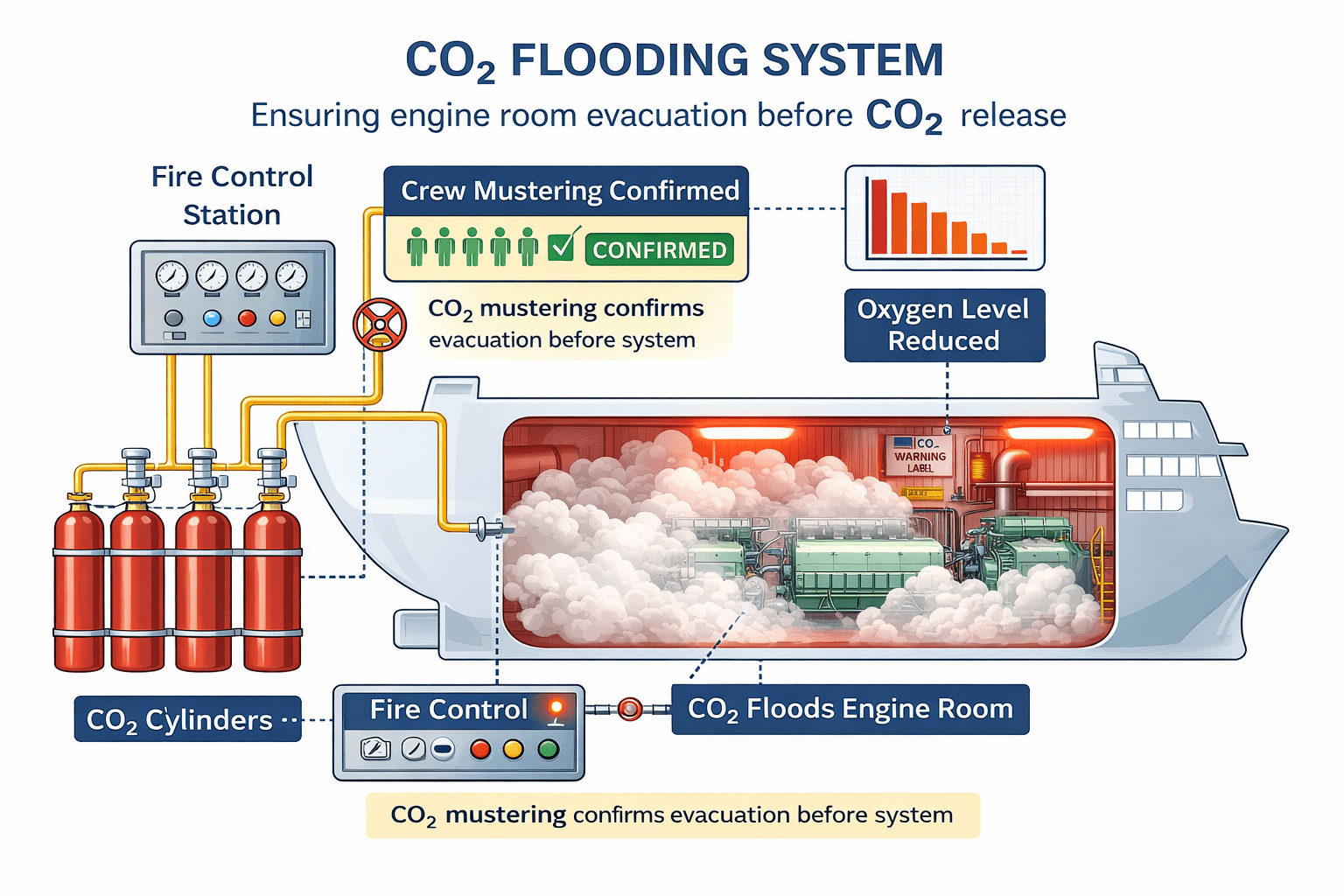
Fixed CO₂ flooding systems are widely used to protect machinery spaces on ships because they are extremely effective at suppressing fires involving fuel and machinery. When released into a sealed engine room, CO₂ reduces oxygen levels below the threshold required for combustion.
However, this also makes the atmosphere immediately dangerous for humans. In enclosed spaces, CO₂ flooding typically reduces oxygen concentration to approximately 12–15%, which is sufficient to extinguish fires but extremely hazardous for personnel.
Because of this risk, maritime safety procedures require crews to complete several steps before CO₂ release:
- shutting down machinery
- stopping ventilation systems
- evacuating all personnel
- confirming the space is empty
Only then can CO₂ flooding be activated. On large cruise ships, this process can take significant time because machinery spaces may span multiple decks and compartments. During this delay, a fire may continue to grow, increasing the risk of severe damage or loss of propulsion.
Why ships rely on cameras to verify engine room evacuation
Most modern vessels are equipped with CCTV systems in machinery spaces. These cameras allow engineers to monitor operations remotely and can also be used during emergencies to visually inspect the engine room.
The intended process appears straightforward:
- fire is detected
- officers check the camera feed
- they confirm no crew remain inside
- CO₂ flooding is released
At first glance, this approach seems efficient. But in real emergency conditions, camera systems quickly reveal their limitations.
Five reasons cameras fail during engine room fires
Smoke rapidly obscures visibility
Engine room fires produce dense smoke within minutes. Because most CCTV systems rely on visible light, their effectiveness drops dramatically once smoke fills the space.
In heavy smoke conditions, camera images can become blurred or completely opaque, making it impossible to determine whether someone remains inside the engine room.
Engine rooms have many blind spots
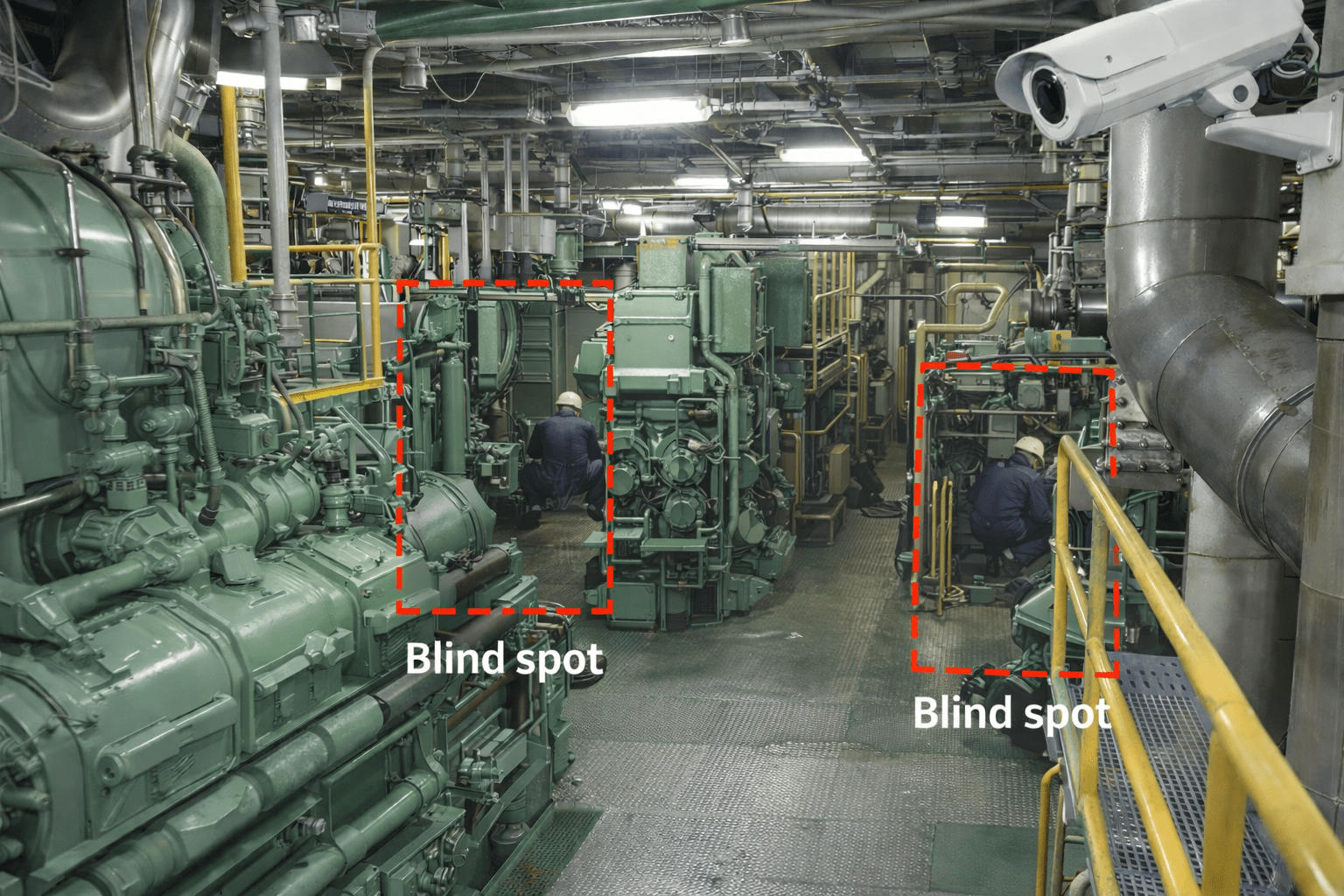
Engine rooms are highly complex environments. They often span multiple decks and contain large pieces of machinery such as generators, propulsion equipment, fuel treatment systems and ventilation ducts. Even with multiple cameras installed, achieving full visual coverage is extremely difficult.
Large equipment blocks camera views, creating blind spots where a person could remain hidden. For routine monitoring this may be acceptable. But when the decision involves releasing gas that removes breathable oxygen from the space, even a small blind spot represents unacceptable risk.
Fires can disable camera infrastructure
Engine room fires frequently affect electrical systems. Power loss, damaged cables or network failures may interrupt camera feeds during an emergency. Ironically, the moment when visual confirmation becomes most critical is also the moment when cameras are most likely to stop working.
If a video feed disappears during a fire, officers must decide whether to delay suppression or proceed without confirmation. Neither option is ideal.
Human monitoring is difficult under pressure
Even if cameras remain operational, someone must interpret the video feed. During a real emergency, crews are dealing with multiple simultaneous tasks such as responding to alarms, shutting down machinery, coordinating firefighting operations and communicating with the bridge.
Expecting operators to carefully scan several camera feeds and confidently declare that a multi-deck engine room is completely empty can be extremely challenging. Under stress, mistakes can happen.
Cameras cannot confirm evacuation
Perhaps the most fundamental limitation is conceptual. Cameras can show whether someone is visible. But they cannot answer the critical question:
Has everyone who was inside the engine room safely evacuated? A camera might show an empty area while a crew member remains behind machinery, unconscious from smoke or in a compartment outside the camera’s field of view. For safety-critical decisions like CO₂ flooding, uncertainty is unacceptable.
The operational dilemma for ship operators
This limitation creates a difficult trade-off. If operators wait for manual confirmation that the engine room is empty, they risk delaying suppression while the fire spreads. If they rely on incomplete camera verification, they risk releasing CO₂ while someone remains inside.
Neither option is ideal. Given the potential consequences, the maritime industry continues to search for better ways to confirm evacuation quickly and reliably.
Why crew accountability is the missing piece
What officers really need during an engine room emergency is instant crew accountability.
In other words, they must be able to answer three questions immediately:
- who was inside the engine room
- who has evacuated the space
- whether anyone remains missing
Without this information, the decision to release CO₂ remains uncertain. Crew tracking and digital mustering technologies provide a solution to this problem.
Digital mustering improves engine room safety
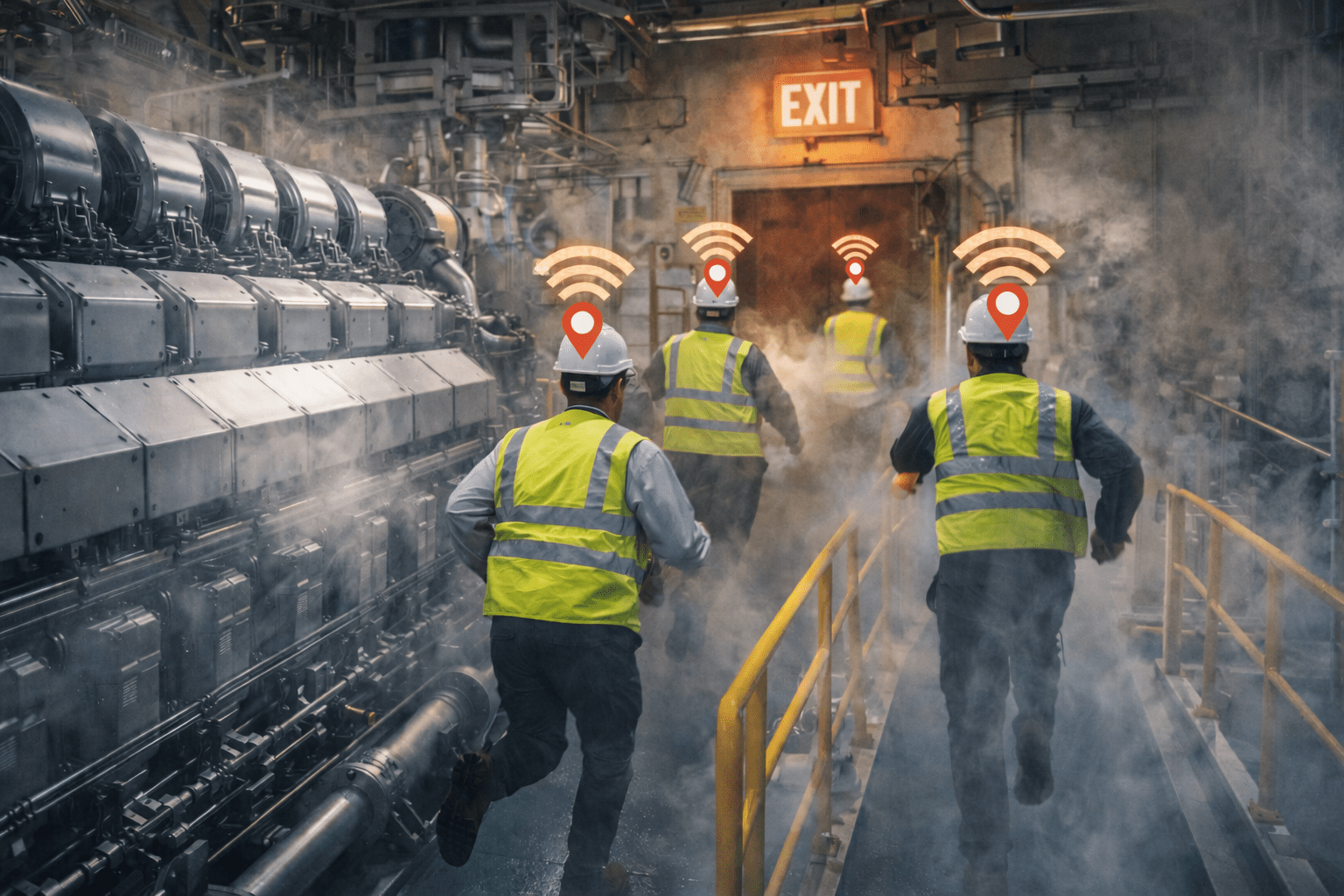
Modern cruise ships are increasingly implementing digital mustering and crew tracking systems. These systems track the presence of crew members in real time using technologies such as RFID or wearable devices. During an emergency, officers can immediately identify the location of crew members throughout the ship.
In the context of an engine room fire, this allows them to verify:
- which crew members were working in the machinery space
- whether those crew members have exited
- if anyone remains inside the protected area
This dramatically improves situational awareness during emergencies. Instead of relying on uncertain visual confirmation, officers can make decisions based on verified crew data.
From cameras to CO₂ mustering
This approach is known as CO₂ mustering. Rather than relying on cameras to visually detect people during a fire, the system continuously tracks crew presence and evacuation status. When an emergency occurs, officers can instantly confirm whether the engine room has been fully evacuated.
This provides the operational certainty required before activating CO₂ flooding systems. It also reduces response time, which is critical given that even short delays can significantly increase fire damage.
Improving safety in modern cruise ships
As ships become larger and more technologically complex, traditional safety procedures must evolve. Cameras will continue to play an important role in monitoring engine room operations.
However, when it comes to life-critical decisions such as releasing CO₂ into a machinery space, visual confirmation alone cannot provide the certainty required.
The future of maritime fire safety will rely on combining multiple technologies:
- fire detection systems
- emergency response procedures
- real-time crew tracking and digital mustering
Together, these systems allow ship operators to respond faster while maintaining the highest safety standards.
A smarter approach: CO₂ mustering systems
One example of this next-generation safety approach is the CO₂ Mustering system developed by Pole Star.
Designed specifically for cruise ships and large vessels, the system provides real-time visibility into crew locations, allowing officers to confirm that all personnel have evacuated before CO₂ flooding is activated.
By combining crew accountability with existing fire suppression procedures, operators can significantly improve both safety and response speed during engine room emergencies.