
Introduction
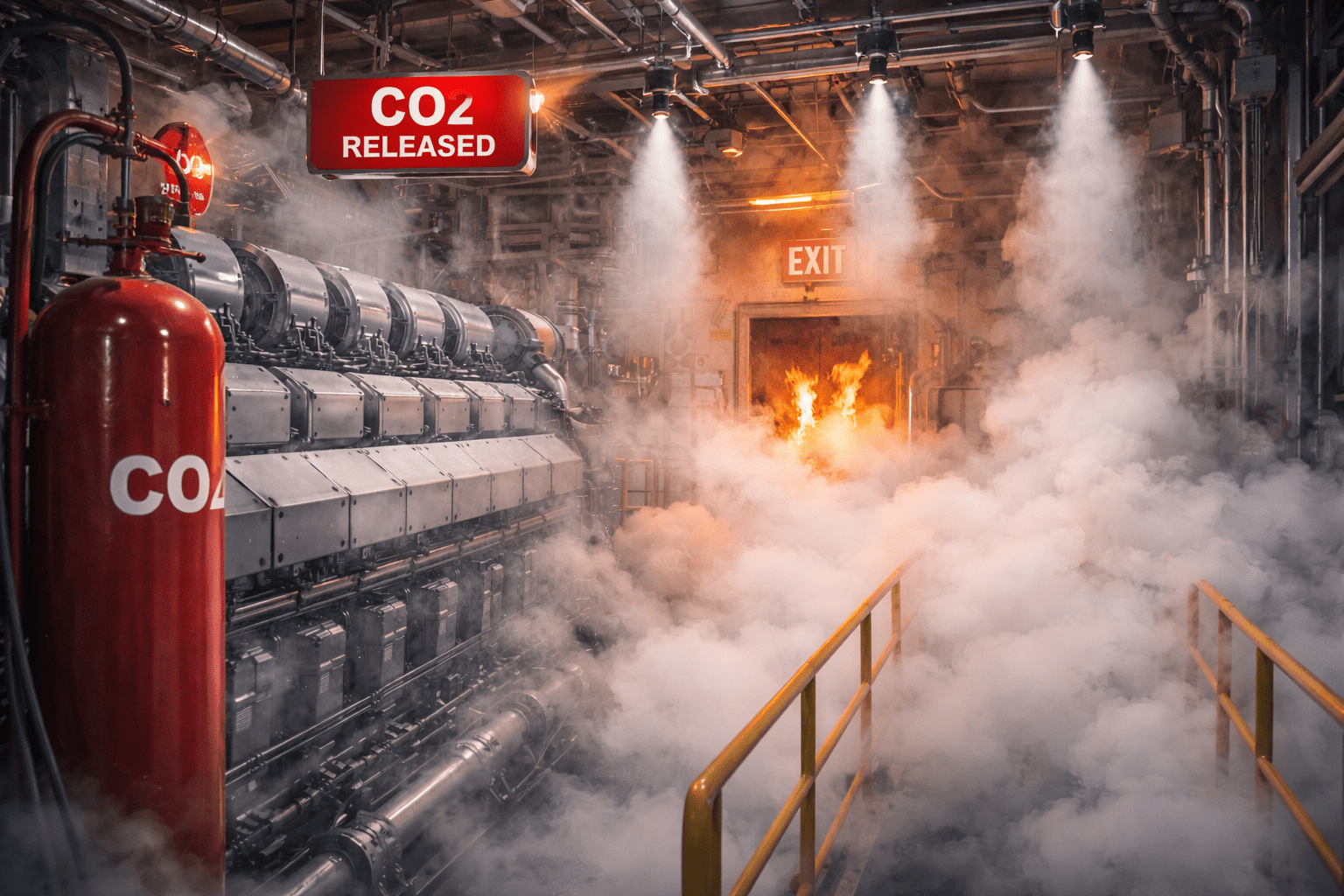
In a cruise ship engine room fire, the decision to release CO₂ is one of the most critical actions taken onboard. The fixed firefighting system is designed to suppress flames instantly by displacing oxygen, creating an environment where combustion cannot continue. However, the system does not differentiate between fire and human presence.
If even one crew member remains inside a protected space at the moment of discharge, the consequences are immediate and irreversible. The atmosphere becomes lethal within seconds.
For this reason, evacuation verification before CO₂ activation is not merely a procedural checkpoint. It is a life-critical requirement embedded in maritime safety philosophy.
Yet on many vessels, confirmation still relies on manual headcounts, radio communications or CCTV checks. These methods introduce uncertainty in an environment where uncertainty simply cannot exist. A cruise ship CO2 mustering system replaces assumption with real-time certainty.
Why manual CO2 verification is no longer sufficient
Engine rooms and CO₂-protected technical areas are structurally complex environments. They are multi-level, metallic, compartmentalized and often extremely noisy. During an emergency, smoke may reduce visibility, alarms may overlap and communications may be partially disrupted.
Traditional evacuation confirmation typically depends on verbal radio checks, manual headcounts, visual inspection through CCTV or written procedural logs. While these processes have been standard practice for decades, they rely heavily on perfect coordination under high stress.
Even well-trained crews are vulnerable to verification gaps. A missed confirmation, a blind spot behind heavy machinery, or a delayed radio response can create fatal consequences if CO₂ is released prematurely. Human reliability, especially under emergency pressure, has limits.
A cruise ship CO2 mustering system removes this vulnerability by introducing continuous, automated occupancy awareness inside protected zones. Instead of asking whether everyone has exited, the system shows whether anyone remains.
What is a cruise ship CO2 mustering system?
A cruise ship CO2 mustering system is a real-time indoor localization solution specifically configured for high-risk technical spaces such as engine rooms, generator compartments, machinery control areas and other CO₂-protected enclosures.
Its primary objective is straightforward but critical: verify with absolute certainty that no crew member remains inside a protected zone before CO₂ discharge is authorized.
The system combines wearable BLE badges carried by crew members, detection infrastructure installed throughout technical areas, and a real-time location engine operating fully on-premise. Together, these components create a live digital map of human presence inside defined safety perimeters.
Instead of relying on verbal confirmation, safety officers gain a continuously updated, actionable view of personnel exposure within CO₂-protected spaces.
How a cruise ship CO2 mustering system works in practice
CO₂-protected zones require permanent supervision of human presence. The system operates through multiple integrated layers that ensure precise enclosed space crew verification without disrupting normal operations.
Continuous BLE badge emission
Crew members working in engine rooms and technical spaces are equipped with BLE identification badges. These devices continuously emit encrypted Bluetooth Low Energy signals at predefined intervals. The emission is automatic and passive, meaning crew members do not need to take any action during normal operations.
Designed for demanding maritime environments, the badges are lightweight, resistant to vibration and heat, and optimized for long battery autonomy. Each badge also includes an emergency push button. If a crew member encounters a critical situation, pressing this button immediately triggers an alert, allowing rapid escalation through the monitoring system.
This ensures that the cruise ship CO2 mustering system supports both passive supervision and active distress signaling.
Signal capture through onboard infrastructure
The BLE signals emitted by badges are captured by receivers strategically installed throughout CO₂-protected areas. These anchors ensure coverage across engine room decks, machinery compartments, corridors and access points.
Captured signals are transmitted via the vessel’s internal network to a local onboard server hosting the location engine. Because the architecture is fully on-premise, signal processing does not depend on cloud connectivity or satellite communication.
This design guarantees ultra-low latency and uninterrupted operation, even in situations where external connectivity is unstable or unavailable. In critical safety environments, operational independence is essential.
Real-time position computation
At the core of the cruise ship CO2 mustering system lies the onboard location engine. Using advanced signal processing algorithms, the engine filters interference typical of metallic engine environments and computes badge positions within predefined safety zones.
Protected areas are digitally mapped within the system. When a badge is detected inside a defined perimeter, the individual is automatically registered as present. When the badge exits the zone, the system updates occupancy status in real time.
This continuous monitoring enables accurate tracking of personnel exposure inside CO₂-protected spaces, ensuring that no hidden compartment or blind spot compromises verification.
Automated headcount and evacuation supervision
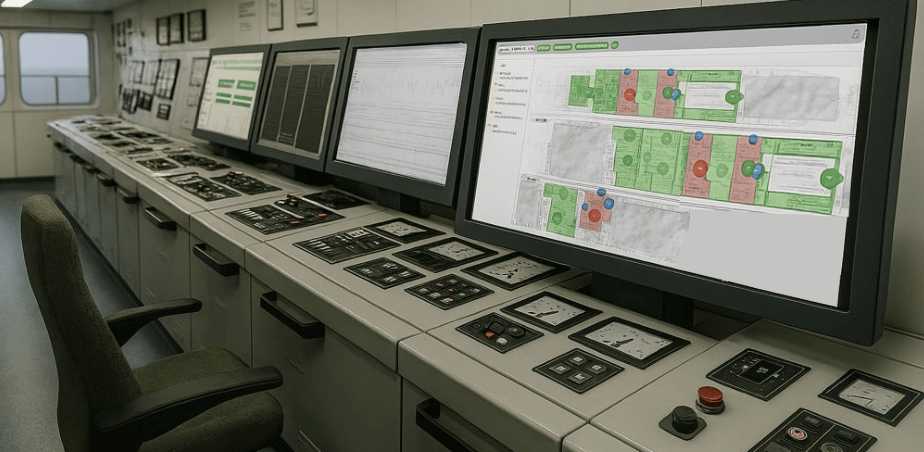
When a CO₂ alert is triggered, the system instantly generates an automatic headcount of all personnel present within the protected zone. A dedicated CO₂ mustering dashboard displays the number of individuals still inside, identifies exposed crew members and tracks evacuation progress in real time.
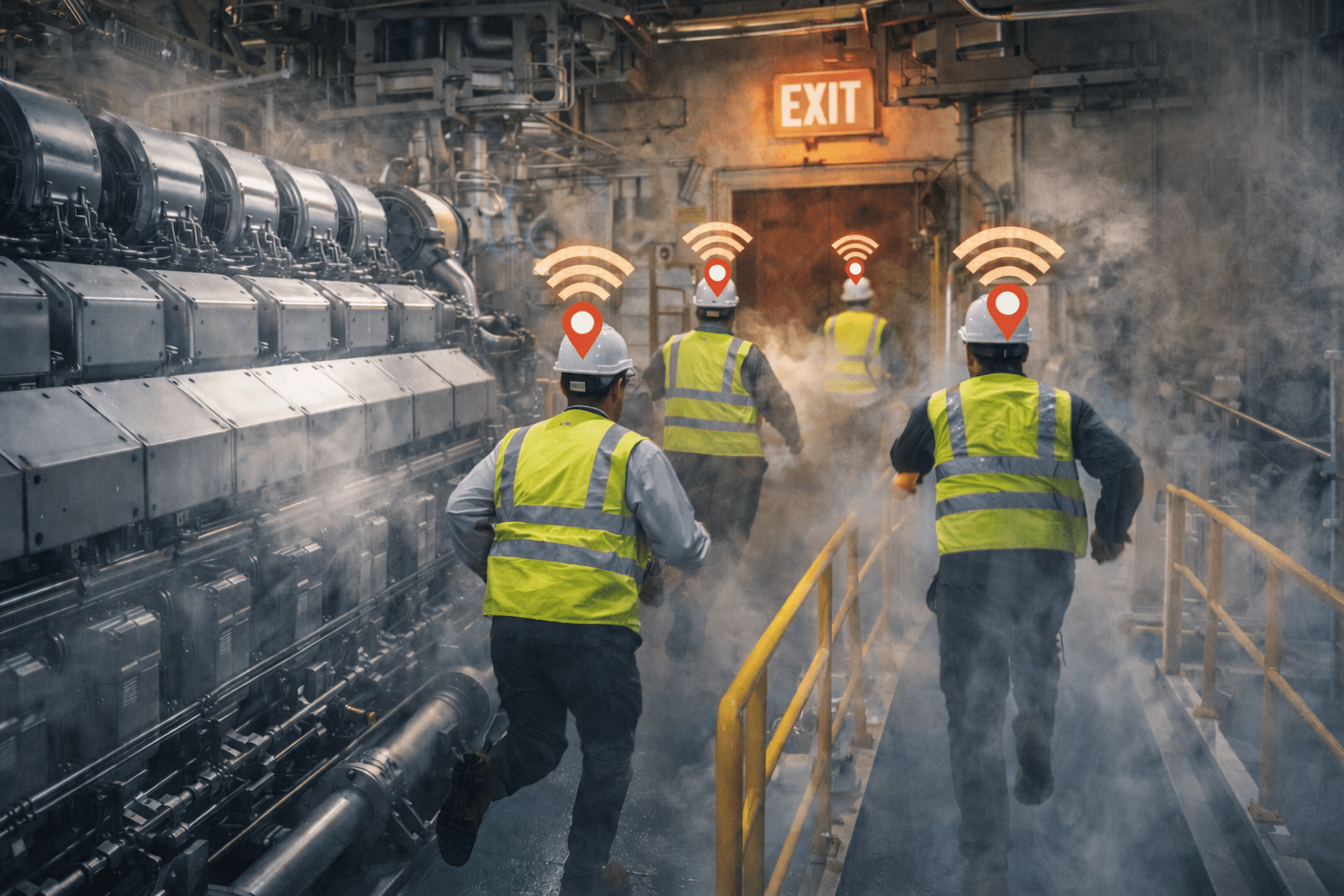
As crew members exit the zone, the system updates occupancy status dynamically. Only once the dashboard confirms that no active badge remains within the defined perimeter can CO₂ release be authorized.
This transforms evacuation from procedural confirmation into digital verification. Additionally, each event is logged with timestamps and personnel identification, creating a complete audit trail for compliance, reporting and post-incident analysis.
Strengthening compliance with international maritime safety standards
International maritime safety regulations require that evacuation be confirmed before fixed CO₂ systems are activated. While these frameworks emphasize procedural safeguards, authorities and classification bodies increasingly examine the reliability and traceability of verification mechanisms in high-risk technical areas.
A cruise ship CO2 mustering system enhances compliance by introducing objective evacuation confirmation, digital proof of zone clearance and time-stamped authorization records. Instead of relying solely on verbal confirmation or written logs, operators gain measurable and auditable verification of crew safety prior to CO₂ discharge.
As maritime safety standards continue to evolve, digital verification is becoming a benchmark for managing risk in enclosed engine room and CO₂-protected environments.
Why CCTV alone cannot guarantee occupancy certainty
Cameras provide visual confirmation, but they cannot guarantee occupancy certainty. Engine rooms contain blind spots, hidden compartments and structural obstacles that can obscure personnel from view. Smoke accumulation and lighting conditions further reduce visibility during emergencies.
CCTV systems confirm what is visible. They do not confirm who is present.
A cruise ship CO2 mustering system detects individual presence regardless of line-of-sight limitations, ensuring that no crew member remains unnoticed within protected zones.
Reducing legal, financial and operational exposure
Improper CO₂ activation can lead to severe injury, fatality, criminal investigation, civil liability claims and insurance disputes. Beyond immediate human consequences, operators may face port state detention and long-term reputational damage.
By transforming evacuation confirmation into a digitally verified process, operators significantly reduce exposure to human error. Real-time crew accountability converts safety from a procedural obligation into measurable risk mitigation.
For fleet operators managing vessels across multiple jurisdictions, this level of defensibility is strategically valuable.
Why on-premise architecture is critical at sea
Critical safety systems must operate independently of external connectivity. A cruise ship CO2 mustering system deployed in a fully on-premise architecture ensures ultra-low latency, high availability and operational autonomy.
In maritime emergency scenarios, reliance on unstable satellite communication is unacceptable. Autonomy and resilience are not technological preferences — they are safety requirements.
Conclusion: 100% verification Is the only acceptable standard
When CO₂ is released inside an engine room, there is no margin for approximation. Evacuation must be verified with certainty, not assumed through procedural confirmation.
A cruise ship CO2 mustering system provides continuous visibility of human presence, automated headcount during alerts and verified evacuation before discharge. It strengthens SOLAS compliance, reduces liability exposure and significantly enhances safety in CO₂-protected areas.
In enclosed maritime environments, 100% verification is not an option. It is the only acceptable standard.
The Pole Star system is designed to complement existing safety procedures and verification methods by providing an additional layer of real‑time visibility that supports, but does not replace, human judgment, established protocols, or the regulatory decision‑making process prior to CO₂ release.