

Introduction
Airports are among the most complex operational environments, where thousands of assets, vehicles and personnel must be coordinated in real time across terminals, baggage areas and airside zones.
According to the International Air Transport Association (IATA), over 4.5 billion passengers travel by air each year, significantly increasing pressure on airport infrastructure and ground operations.
In such high-pressure environments, the lack of visibility on equipment and operations quickly leads to inefficiencies, delays and increased operational costs.
This is where airport asset tracking, powered by RTLS (Real-Time Location Systems) and indoor/outdoor positioning technologies, becomes critical. By providing real-time visibility across the entire airport ecosystem, these systems enable operators to optimize workflows, improve resource utilization and make faster, data-driven decisions.
What is airport asset tracking
Airport asset tracking refers to the ability to locate and monitor equipment, vehicles and operational resources in real time across airport environments.
Modern airport tracking systems rely on technologies such as Bluetooth Low Energy (BLE), Wi-Fi positioning and hybrid indoor/outdoor location engines to provide continuous tracking across all operational zones.
This creates a unified layer of visibility across terminals, baggage handling areas and airside operations, allowing airports to move from fragmented supervision to centralized, real-time control.
Why asset tracking is critical for airport operations
Airport operations are highly dynamic and time-sensitive. Equipment must be available instantly, teams must be coordinated efficiently and workflows must adapt continuously to changing conditions.
Without a RTLS airport system, operations often rely on manual processes or incomplete data, resulting in:
- time lost searching for assets
- inefficient resource allocation
- operational delays
- limited visibility across zones
With real-time asset tracking, airports gain full operational awareness. Teams can anticipate shortages, rebalance resources proactively and ensure smooth coordination across all activities.
Key use cases of airport asset tracking with Pole Star
Pole Star delivers advanced airport asset tracking solutions designed specifically for large-scale airport environments. By combining BLE, RTLS and hybrid indoor/outdoor location, the platform provides real-time visibility across assets, staff and ground operations.
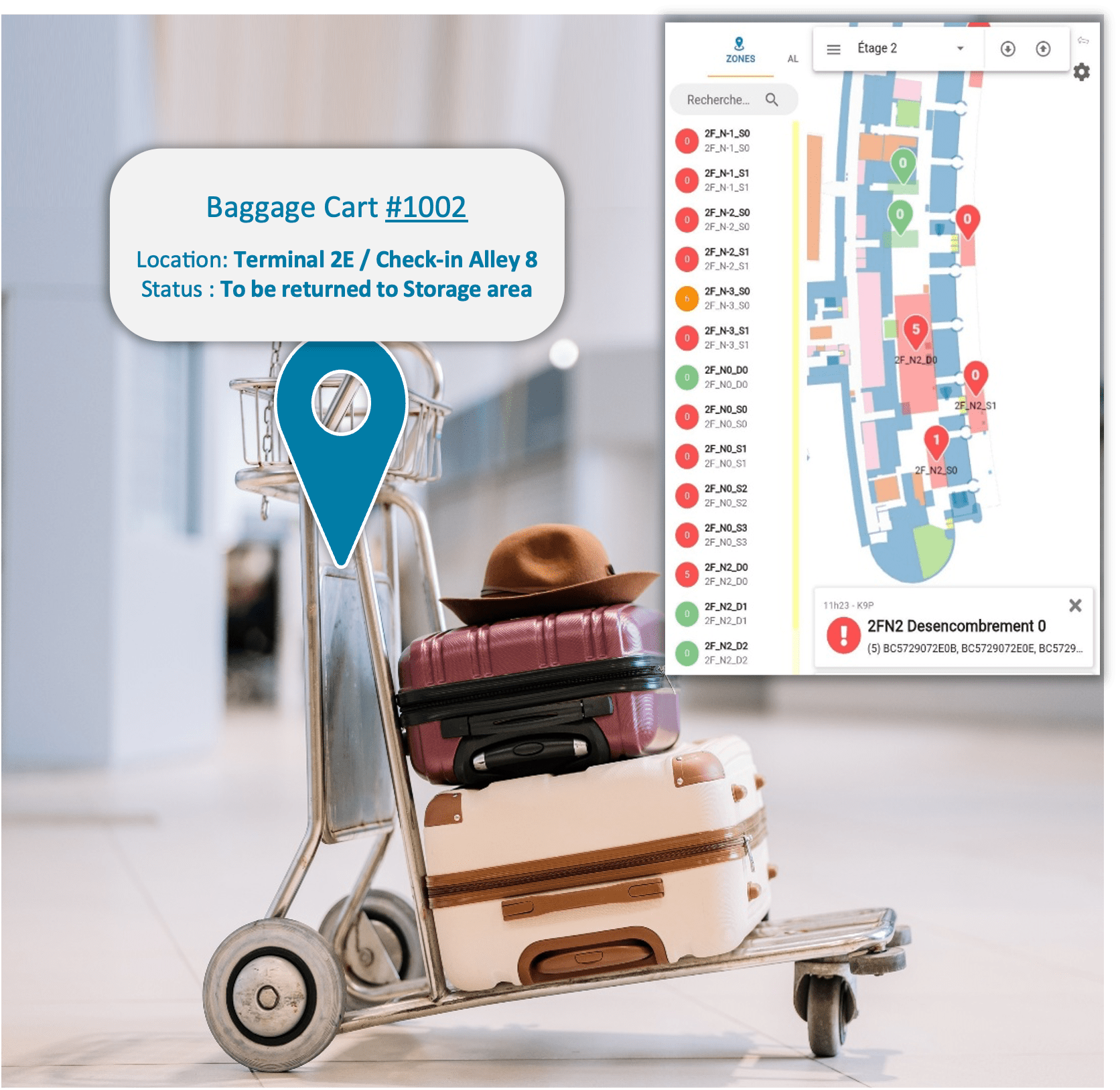
Baggage cart tracking and asset optimization
Pole Star enables airports to track thousands of baggage carts in real time across check-in areas, terminals, arrival halls and passenger circulation zones.
Each cart is equipped with a BLE tag that continuously emits signals captured by the airport’s existing infrastructure. These signals are processed by Pole Star’s location engine to calculate precise positions and provide zone-based visibility.
Operations teams can:
- monitor cart availability in real time
- detect imbalances between high-demand and low-demand zones
- eliminate manual inventory processes
- optimize redistribution workflows
When abnormal situations occur, such as shortages during peak hours or unused carts remaining in low-traffic areas, intelligent alerts are triggered automatically.
By leveraging historical movement data, airports can refine allocation strategies, reduce asset loss and significantly improve operational efficiency.
Agent and baggage tractor tracking
Pole Star provides a smartphone-based RTLS solution that enables real-time tracking of ground agents and baggage tractors across indoor and outdoor environments.
By using professional mobile devices, airports can deploy a scalable and cost-efficient tracking system without additional hardware complexity.
This enables:
- continuous tracking of agents and vehicles across terminals and airside zones
- live visibility of operations
- dynamic task assignment based on real-time conditions
- improved coordination during aircraft turnaround
Supervisors gain a unified operational view, allowing them to react instantly to disruptions such as delays, congestion or equipment shortages.
Baggage flow monitoring and congestion detection
Pole Star extends asset tracking capabilities to baggage flow monitoring, providing real-time insights into operational bottlenecks.
By analyzing movement patterns, the system can detect saturation at critical points such as baggage sorter infeed areas. This allows operators to anticipate congestion and adjust workflows proactively.
As a result:
- bottlenecks are reduced
- baggage handling becomes smoother
- turnaround performance improves
Indoor and outdoor tracking continuity
Airport operations require seamless tracking across indoor and outdoor environments.
Pole Star provides a unified location layer that ensures continuous tracking as assets, agents and vehicles move between terminals, baggage areas and airside zones.
This eliminates operational blind spots and enables full end-to-end visibility across the airport ecosystem.
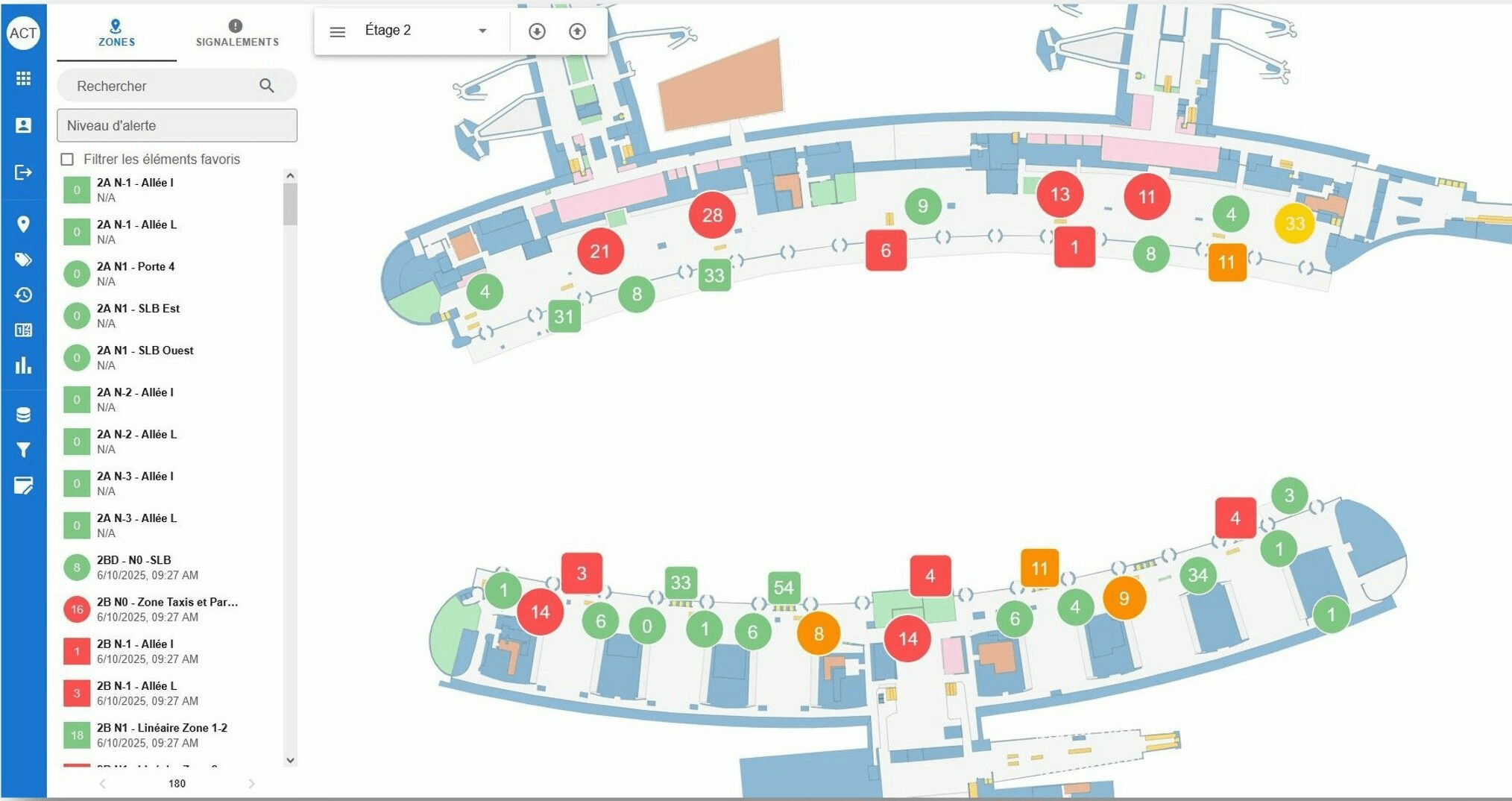
Real-time supervision and operational analytics
Pole Star transforms raw location data into actionable operational intelligence.
Through real-time dashboards and analytics, airport teams can:
- monitor asset availability and utilization
- analyze movement patterns
- track operational performance
- optimize resource allocation
This allows airports to move from reactive operations to proactive, data-driven decision-making.
Scalable asset tracking for large airports
Pole Star solutions are designed to support thousands of assets across multiple terminals and operational zones.
By leveraging existing infrastructure and modular deployment models, airports can implement asset tracking quickly and efficiently while ensuring scalability.
This makes it possible to expand tracking capabilities as operations grow without major infrastructure changes.
Benefits of airport asset tracking
Airport asset tracking delivers measurable improvements across multiple dimensions.
Operational efficiency increases as teams gain real-time visibility and reduce time spent searching for equipment. Resource utilization improves, leading to lower operational costs and fewer lost assets.
Ground operations become more fluid, with better coordination between teams and faster turnaround times. At the same time, passenger experience improves thanks to better equipment availability and reduced friction across the airport journey.
Conclusion
Airport asset tracking is becoming a critical foundation for modern airport operations.
By combining RTLS, indoor/outdoor location and real-time analytics, solutions like Pole Star enable airports to gain full visibility, optimize workflows and improve performance at scale.
More than a tracking tool, asset tracking is a strategic enabler of smarter, more efficient and more resilient airport operations.