
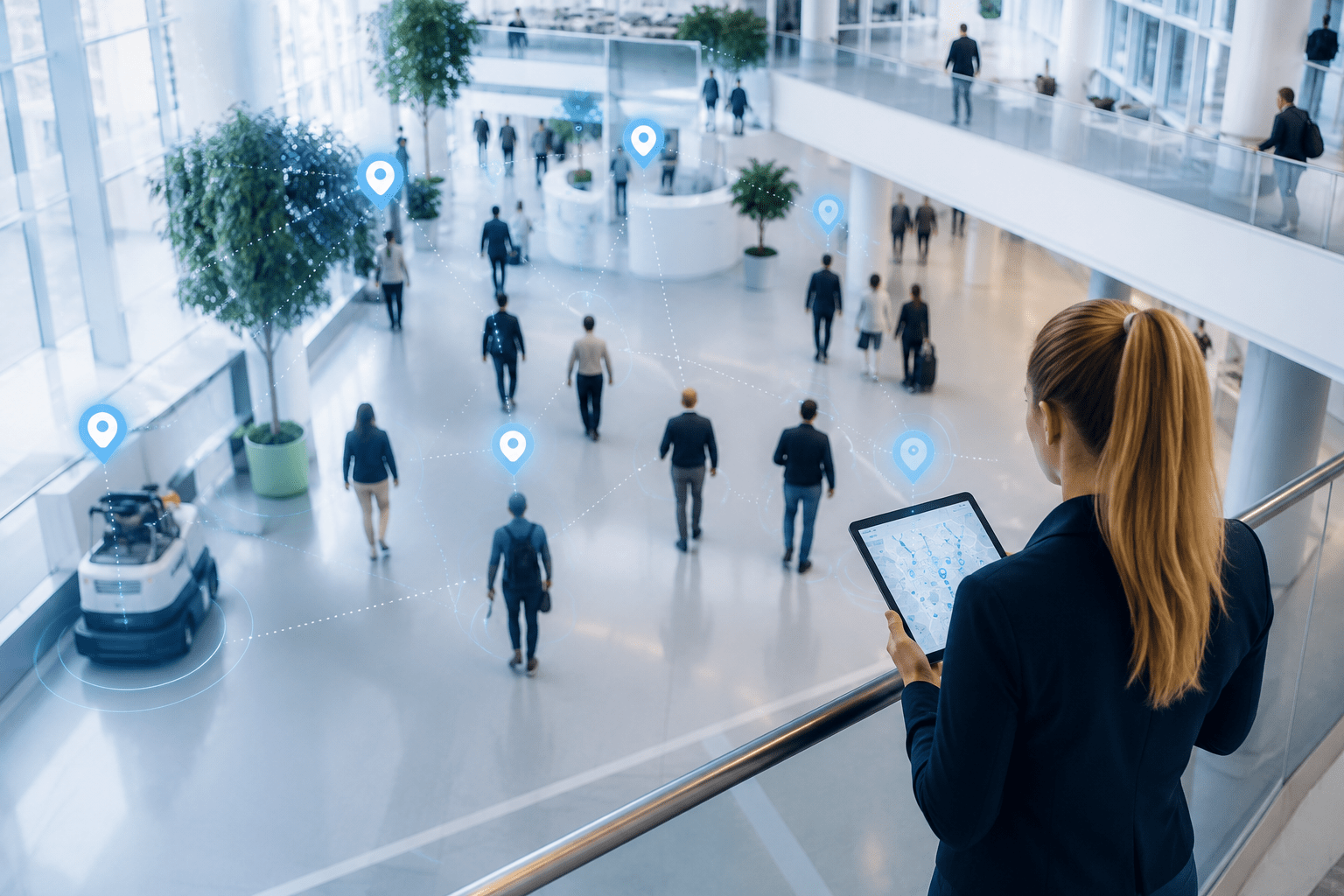
Indoor environments have become increasingly complex. Airports, hospitals, factories, warehouses, and corporate campuses rely on thousands of assets, employees, and operational processes that move continuously throughout the day. Yet traditional GPS technology, while highly effective outdoors, cannot provide the level of visibility required inside buildings.
This challenge has fueled the rapid adoption of Indoor Positioning Systems (IPS), technologies designed to deliver real-time location intelligence in environments where satellite-based positioning falls short.
Whether organizations aim to improve operational efficiency, optimize asset utilization, enhance workforce productivity, or deliver better user experiences, Indoor Positioning Systems have become a cornerstone of digital transformation strategies.
This guide explores how IPS technology works, compares the main positioning technologies available today, examines enterprise use cases across industries, and explains how organizations can select the right solution for their needs.
What is an Indoor positioning system (IPS)?
An Indoor Positioning System (IPS) is a technology solution that determines the real-time location of people, assets, vehicles, or mobile devices within indoor environments.
Unlike GPS, which relies on satellite signals, IPS technologies use local infrastructure and wireless signals to calculate positions inside buildings, terminals, campuses, warehouses, and industrial sites.
Indoor Positioning Systems provide organizations with accurate visibility into operational activities, enabling them to make better decisions and optimize processes in real time.
Why GPS does not work indoors
GPS signals originate from satellites orbiting thousands of kilometers above Earth.
When these signals encounter walls, ceilings, metal structures, and other physical obstacles, their strength deteriorates significantly.
As a result, GPS often delivers poor accuracy or becomes entirely unavailable indoors.
Common GPS limitations indoors include:
- Signal attenuation through building materials
- Multi-path signal reflections
- Loss of satellite visibility
- Reduced positioning reliability
- Inconsistent location updates
These limitations make GPS unsuitable for mission-critical indoor operations.
IPS vs GPS
| Feature | GPS | Indoor Positioning System |
|---|---|---|
| Indoor positioning | No | Yes |
| Outdoor positioning | Yes | Limited |
| Typical accuracy | 5–15 meters | 0.3–5 meters |
| Infrastructure | Satellites | Local infrastructure |
| Real-time operational tracking | Limited | Excellent |
| Asset tracking | Limited | Excellent |
| Workforce tracking | Limited | Excellent |
How indoor positioning systems work
Indoor Positioning Systems combine signal measurements, location algorithms, and analytics platforms to determine positions within a facility.
Although technologies differ, most IPS deployments follow a similar process.
Step 1: Signal detection
A smartphone, badge, wearable device, vehicle, or tracking tag emits or receives signals.
These signals can be based on:
- Bluetooth Low Energy (BLE)
- Ultra-Wideband (UWB)
- Wi-Fi
- RFID
- Magnetic fields
Step 2: Signal measurement
The system measures signal characteristics such as:
- Signal strength
- Time of flight
- Signal angle
- Environmental fingerprints
These measurements provide the data needed to estimate location.
Step 3: Position calculation
Location engines use algorithms such as:
Trilateration
Calculates a position based on distances from multiple reference points.
Triangulation
Uses signal angles from multiple sensors.
Fingerprinting
Matches observed signal patterns against previously mapped environments.
Step 4: Location visualization
The calculated position is displayed through dashboards, maps, mobile applications, or operational management systems.
Organizations gain immediate visibility into:
- Asset locations
- Employee positions
- Vehicle movements
- Facility utilization
- Operational bottlenecks
Indoor Positioning technologies explained
Several technologies are used to provide indoor location services.
Each offers distinct advantages depending on accuracy requirements, deployment constraints, and business objectives.
Bluetooth low energy (BLE) positioning
Bluetooth Low Energy has become one of the most widely deployed indoor positioning technologies worldwide.
BLE positioning uses a network of beacons and receivers to determine location through signal strength measurements.
Advantages of BLE
- Cost-effective deployment
- Easy scalability
- Smartphone compatibility
- Low power consumption
- Suitable for large facilities
Limitations of BLE
- Accuracy varies depending on environment
- Signal interference may occur
- Requires calibration for optimal performance
Typical accuracy
1 to 5 meters.
Best applications
- Airports
- Hospitals
- Shopping malls
- Corporate campuses
- Visitor navigation
Ultra-wideband (UWB) positioning
Ultra-Wideband technology provides highly accurate indoor positioning.
By measuring the precise travel time of radio signals, UWB can achieve centimeter-level accuracy.
Advantages of UWB
- Extremely high precision
- Reliable real-time tracking
- Suitable for mission-critical operations
Limitations of UWB
- Higher infrastructure costs
- More complex deployment
- Requires dedicated hardware
Typical accuracy
10 to 30 centimeters.
Best applications
- Manufacturing
- Industrial automation
- Robotics
- High-value asset tracking
Wi-Fi positioning
Wi-Fi positioning leverages existing wireless infrastructure to estimate locations.
Organizations often choose Wi-Fi positioning when minimizing deployment costs is a priority.
Advantages of Wi-Fi
- Existing infrastructure
- Lower deployment effort
- Broad coverage
Limitations
- Lower positioning accuracy
- Signal fluctuations
- Less suitable for critical tracking
Typical accuracy
5 to 15 meters.
RFID positioning
Radio Frequency Identification (RFID) is commonly used for identification and asset management.
Although not always designed for real-time positioning, RFID remains valuable for specific tracking scenarios.
Advantages
- Low-cost tags
- Asset identification
- Inventory management
Limitations
- Limited continuous tracking
- Reduced real-time visibility
Best Applications
- Inventory control
- Warehouse operations
- Supply chain management
Magnetic positioning
Magnetic positioning uses natural magnetic field distortions within buildings.
Because buildings create unique magnetic signatures, smartphones can use these patterns to estimate location.
Advantages
- No additional hardware
- Smartphone compatible
- Low infrastructure requirements
Limitations
- Environment-dependent
- Variable accuracy
BLE vs UWB vs Wi-Fi vs RFID
| Criteria | BLE | UWB | Wi-Fi | RFID |
|---|---|---|---|---|
| Accuracy | High | Very High | Medium | Low |
| Cost | Low | High | Medium | Low |
| Scalability | Excellent | Good | Excellent | Good |
| Smartphone Compatibility | Excellent | Limited | Excellent | None |
| Infrastructure Requirements | Medium | High | Low | Medium |
| Real-Time Tracking | Excellent | Excellent | Moderate | Limited |
Enterprise benefits of indoor positioning systems
Organizations invest in IPS solutions because location intelligence directly impacts operational performance.
Improved operational visibility
Managers gain real-time visibility into facility activities.
This visibility enables faster decision-making and better resource allocation.
Better asset utilization
Organizations frequently lose time searching for equipment.
Indoor positioning eliminates this challenge by providing instant asset visibility.
Benefits include:
- Reduced equipment search time
- Improved utilization rates
- Lower replacement costs
Workforce productivity optimization
Employees spend less time locating colleagues, tools, and equipment.
This translates into measurable productivity gains.
Faster response times
Location intelligence helps teams respond more rapidly to incidents, service requests, and operational disruptions.
Enhanced safety and security
Organizations can improve safety through:
- Emergency response coordination
- Personnel accountability
- Restricted zone monitoring
- Evacuation management
Data-driven decision making
Historical location data reveals patterns that help organizations optimize:
- Processes
- Staffing levels
- Space utilization
- Asset allocation
Indoor positioning use cases by industry
Airport
Airports represent one of the most demanding environments for indoor positioning.
Large infrastructures, continuous movement, and strict operational timelines create significant visibility challenges.
Airport asset tracking
Airports manage thousands of mobile assets, including:
- Baggage tractors
- Pushback vehicles
- Ground support equipment
- Maintenance assets
Indoor positioning provides real-time visibility across airport operations.
Workforce tracking
Airport operators can monitor:
- Ground handlers
- Maintenance teams
- Supervisors
- Security personnel
This improves operational coordination and turnaround performance.
Passenger experience
Indoor navigation enables passengers to:
- Find gates
- Locate services
- Navigate terminals
- Reduce travel stress
Healthcare
Hospitals rely heavily on equipment availability and staff coordination.
Medical equipment tracking
Hospitals can track:
- Infusion pumps
- Wheelchairs
- Ventilators
- Mobile diagnostic equipment
Patient flow optimization
Location intelligence helps improve:
- Waiting times
- Care coordination
- Resource allocation
Staff efficiency
Care teams can quickly locate personnel and critical resources.
Manufacturing
Industrial facilities increasingly use location intelligence to support Industry 4.0 initiatives.
Tool tracking
Organizations can monitor:
- Tools
- Equipment
- Production assets
Worker safety
Real-time visibility improves safety management in hazardous environments.
Production optimization
Location analytics identify inefficiencies and bottlenecks.
Logistics and warehousing
Warehouses require precise visibility into inventory and equipment movement.
Inventory visibility
Organizations gain:
- Improved inventory accuracy
- Faster order fulfillment
- Better stock management
Vehicle tracking
Forklifts and warehouse vehicles can be monitored in real time.
Smart buildings and corporate campuses
Modern workplaces increasingly use indoor positioning to optimize facility management.
Applications include:
- Occupancy analytics
- Space utilization monitoring
- Visitor navigation
- Employee services
Cruise ships
Modern cruise ships function like floating cities. With thousands of passengers, hundreds of crew members, and a wide range of onboard services spread across multiple decks, maintaining operational visibility can be a significant challenge.
Indoor Positioning Systems help cruise operators improve both passenger experience and operational efficiency by providing real-time location intelligence throughout the vessel.
Passenger navigation
Large cruise ships can be difficult to navigate, especially for first-time passengers.
Indoor positioning enables:
- Turn-by-turn navigation across decks
- Faster access to restaurants, cabins, and entertainment venues
- Reduced demand on guest services
- Improved passenger satisfaction
Crew and workforce tracking
Crew members are responsible for a wide variety of operational, hospitality, and safety-related tasks.
Real-time location tracking helps operators:
- Improve staff coordination
- Optimize response times
- Enhance service delivery
- Increase operational efficiency
Asset tracking
Cruise operators manage thousands of movable assets, including:
- Maintenance equipment
- Cleaning carts
- Medical equipment
- Safety resources
Indoor Positioning Systems provide instant visibility into asset locations, reducing search times and improving resource utilization.
Safety and emergency response
In emergency situations, knowing the location of passengers and crew can significantly improve response coordination.
Location intelligence supports:
- Emergency evacuation procedures
- Crew accountability
- Restricted area monitoring
- Incident management
Data-driven operations
By analyzing location data, cruise operators can better understand passenger flows and facility usage patterns.
This enables:
- Improved crowd management
- Better space utilization
- Enhanced onboard experiences
- More efficient operational planning
As cruise ships continue to adopt digital transformation initiatives, Indoor Positioning Systems are becoming a key technology for delivering safer, smarter, and more connected passenger experiences.
Indoor navigation vs indoor positioning
These terms are often used interchangeably, but they refer to different capabilities.
| Indoor Positioning | Indoor Navigation |
|---|---|
| Determines location | Provides directions |
| Answers “Where am I?” | Answers “How do I get there?” |
| Supports tracking | Supports guidance |
| Used for analytics | Used for user experience |
Most modern solutions combine both functionalities.
For example, a passenger at an airport may first be located through an Indoor Positioning System and then receive step-by-step navigation instructions to their gate.
Key features to look for in an enterprise IPS platform
Not all Indoor Positioning Systems offer the same capabilities.
Organizations should evaluate several criteria before selecting a solution.
Accuracy
Accuracy requirements vary significantly depending on use cases.
Scalability
The platform should support future expansion without major infrastructure changes.
Smartphone compatibility
Native smartphone positioning reduces hardware costs and simplifies deployment.
Open APIs
Integration capabilities are critical for connecting location intelligence with existing systems.
Cloud deployment
Cloud-native architectures improve scalability and simplify management.
Analytics capabilities
Location data becomes significantly more valuable when combined with advanced analytics.
Security and compliance
Enterprise-grade security remains essential for protecting operational data.
How to choose the right indoor positioning vendor
Selecting the right vendor requires aligning technology capabilities with business objectives.
Organizations should evaluate:
Accuracy requirements
How precise must location tracking be?
Infrastructure constraints
Can additional hardware be installed?
Deployment timeline
How quickly must the solution become operational?
Integration requirements
Will the system connect with existing enterprise platforms?
Scalability needs
Can the solution support future growth?
Total cost of ownership
What are the long-term infrastructure and maintenance costs?
The future of indoor positioning systems
Indoor positioning continues to evolve rapidly.
Several trends are shaping the future of location intelligence.
Artificial intelligence
AI is enabling predictive location analytics and smarter operational recommendations.
Digital twins
Indoor positioning increasingly feeds digital twin platforms with real-time operational data.
Autonomous operations
Location intelligence supports robotics, automation, and autonomous workflows.
Smart airports
Airports are becoming increasingly data-driven, using real-time location insights to optimize every aspect of passenger and operational performance.
Predictive analytics
Organizations are moving beyond visibility toward prediction and optimization.
Why enterprises choose Pole Star for indoor positioning
As organizations seek scalable indoor positioning solutions, they increasingly prioritise flexibility, deployment speed, and operational efficiency.
Pole Star’s NAO® platform has been designed to support large-scale indoor positioning deployments across complex environments including airports, healthcare facilities, industrial sites, and corporate campuses.
The platform combines smartphone-based positioning, real-time location intelligence, and enterprise-grade scalability to help organizations transform location data into operational value.
By reducing infrastructure requirements while maintaining reliable positioning performance, organizations can accelerate deployment and achieve faster returns on investment.
As indoor positioning continues to become a strategic enabler of digital transformation, scalable and flexible location intelligence platforms will play a central role in future operational ecosystems.
Conclusion
Indoor Positioning Systems have become a critical component of modern enterprise operations. By delivering real-time visibility into people, assets, and processes, IPS technologies help organizations improve efficiency, reduce costs, enhance safety, and create better experiences.
As digital transformation initiatives continue to accelerate, location intelligence will play an increasingly strategic role across industries. Organizations that invest in scalable indoor positioning capabilities today will be better positioned to optimize operations and gain a competitive advantage tomorrow.