
NAO Mobile SDK
NAO® Mobile SDK is Pole Star’s indoor location engine for smartphones and smartwatches, designed to bring precise and continuous indoor positioning directly into mobile applications. As a core component of the NAO® Suite, it enables developers and integrators to embed indoor location, tracking and geofencing capabilities into Android and iOS apps.
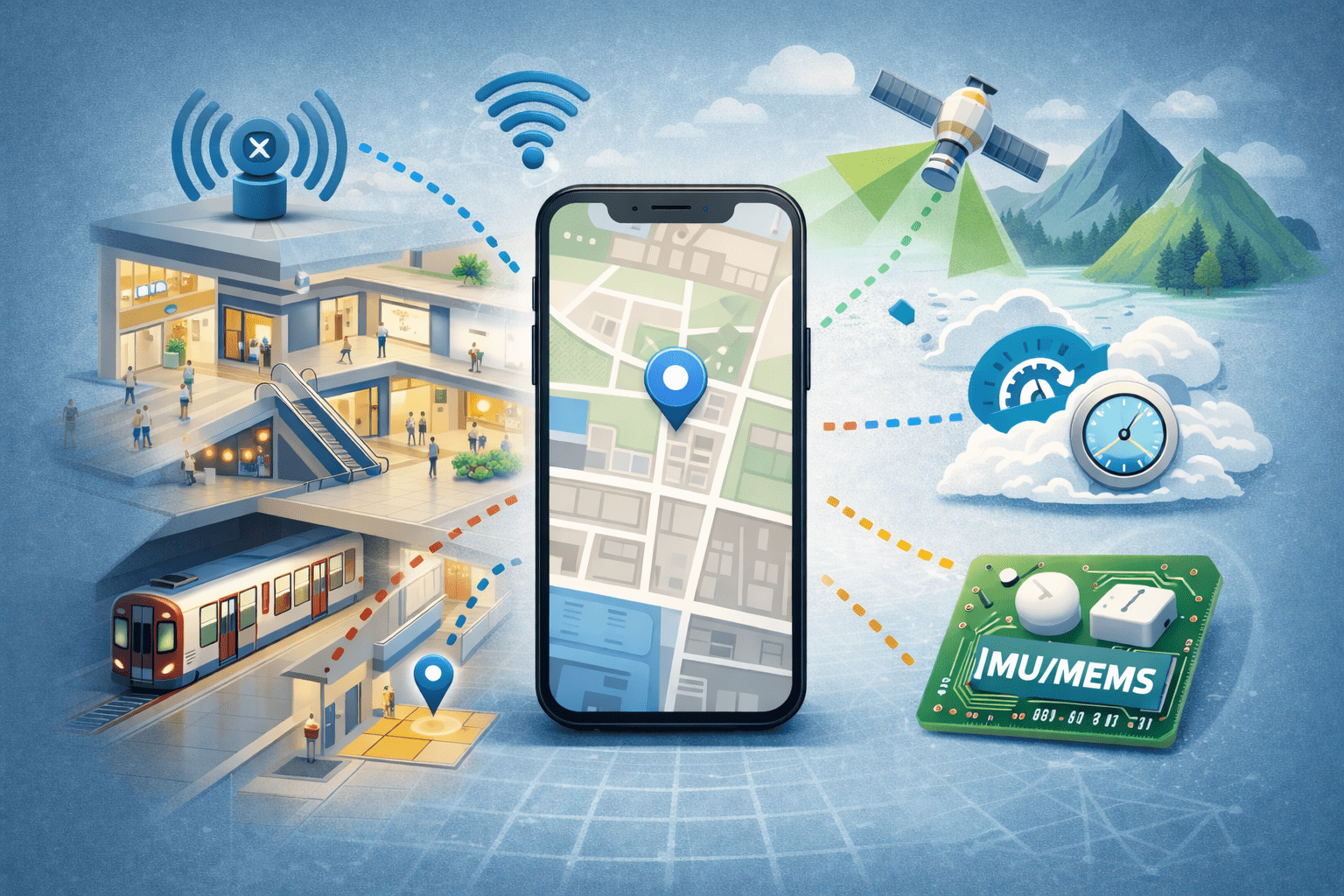
Using a hybrid positioning approach, the SDK combines Bluetooth Low Energy (BLE), Wi-Fi, GNSS and LTE signals with motion and pressure sensors to compute a stable, real-time 3D position (X, Y, floor). This ensures reliable location continuity across indoor, outdoor and transition areas, even in complex environments such as hospitals, airports, industrial sites or transport infrastructures.

Hybrid positioning for complex environments
The NAO® Mobile SDK relies on multi-sensor fusion to deliver accurate and resilient positioning. BLE and Wi-Fi signals are combined with inertial sensors (IMU/MEMS), barometric pressure and outdoor signals to maintain location accuracy where traditional technologies alone are insufficient.
This hybrid approach allows the SDK to handle challenging environments such as multi-floor buildings, underground areas, dense infrastructures or mixed indoor/outdoor spaces, while preserving smooth position updates and floor detection.
Seamless integration with existing infrastructures
Designed for rapid deployment, the NAO® Mobile SDK integrates directly into mobile applications and communicates with NAO® Cloud or NAO® Server for supervision and analytics. Location data can be streamed in real time via standard interfaces, enabling monitoring, alerting and data exploitation across the NAO® ecosystem.
The SDK is compatible with existing Wi-Fi and BLE infrastructures, including Cisco Spaces, HPE Aruba, Extreme Networks and Fortinet, as well as Pole Star hardware components such as NAO® BlueSpot and NAO® BlueListener. This interoperability avoids the need for dedicated infrastructure and simplifies rollout.
Security, privacy and performance by design
Position calculations are performed directly on the mobile device, limiting data exposure and ensuring service continuity even in case of network disruption. All communications are secured through encrypted channels and authenticated access.
The SDK is GDPR-compliant and validated for sensitive environments, including healthcare and critical infrastructure. Its architecture supports large numbers of concurrent users while maintaining consistent accuracy and performance.
Enhancing user experience and contextual services
The NAO® Mobile SDK enables smooth indoor and outdoor navigation experiences without interruption. It supports indoor wayfinding, transition zones and connected outdoor spaces, delivering accurate guidance regardless of building complexity or user density.
Through geofencing and real-time positioning, applications can trigger contextual actions such as notifications, alerts or assistance services based on the user’s location, route or operational context. This makes location a native part of the user experience rather than an isolated feature.
Operational tracking and workforce digitization
Beyond navigation, the SDK enables real-time tracking of staff, mobile teams and assets using standard smartphones. Position data can be leveraged to optimize workflows, coordinate interventions and improve responsiveness in operational environments.
When connected to business systems such as CMMS, supervision platforms or IoT solutions, the SDK transforms mobile geolocation into an operational decision-making tool that supports safety, efficiency and coordination.

Fast deployment and scalable architecture
The NAO® Mobile SDK is designed for ease of integration and scalability. Configuration and calibration are streamlined, supported by dedicated tools such as NAO® Logger, and compatible with existing network infrastructures.
With proven Android and iOS SDKs and flexible configuration options, organizations can deploy mobile location services progressively—from pilot projects to large-scale, multi-site rollouts—while maintaining robustness and long-term scalability.